
MQTT Demystified: Inside the "Post Office" of the IoT World
MQTT is the de facto IoT messaging protocol, designed in 1999 for low-bandwidth, unreliable networks like oil-pipeline monitoring. Unlike HTTP’s request/response model, it uses a lightweight publish/subscribe architecture where devices connect to a central broker, enabling efficient cloud-to-device push without public IPs. Key mechanisms include three QoS levels (at most once, at least once, exactly once), retained messages for late subscribers, Last Will for abnormal disconnects, keep-alive heartbeats, and clean sessions. MQTT 5.0 adds reason codes, shared subscriptions, message expiry, and topic aliases. Compared with HTTP, CoAP, and WebSocket, MQTT offers minimal overhead, flexible reliability, and strong suitability for massive device fleets, low-power sensors, smart homes, industrial IoT, and connected vehicles. The article also provides a runnable Python example using public brokers, helping readers implement their first MQTT publish/subscribe cycle quickly. Readers gain both conceptual understanding and practical starter knowledge.
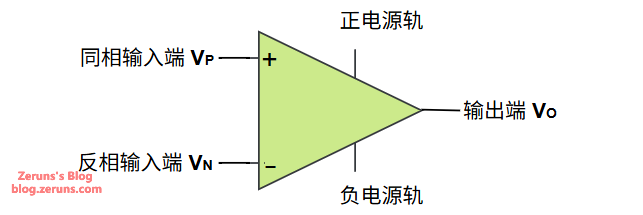
Operational Amplifier (Op-Amp) Beginner's Guide: From Theory to Practice
This beginner guide explains operational amplifiers from fundamentals to practical use. It covers op-amp types, open-loop operation as a comparator, and negative feedback for linear amplification. Key circuits—voltage follower, non-inverting, and inverting amplifiers—are analyzed using virtual short and virtual open concepts, with gain formulas and common pitfalls. It provides selection guidance, essential DC/AC/bandwidth parameters, and hands-on breadboard lab experiments using LM358. Readers gain the ability to analyze entry-level op-amp circuits, avoid typical mistakes, and build and test basic amplifier circuits with confidence.
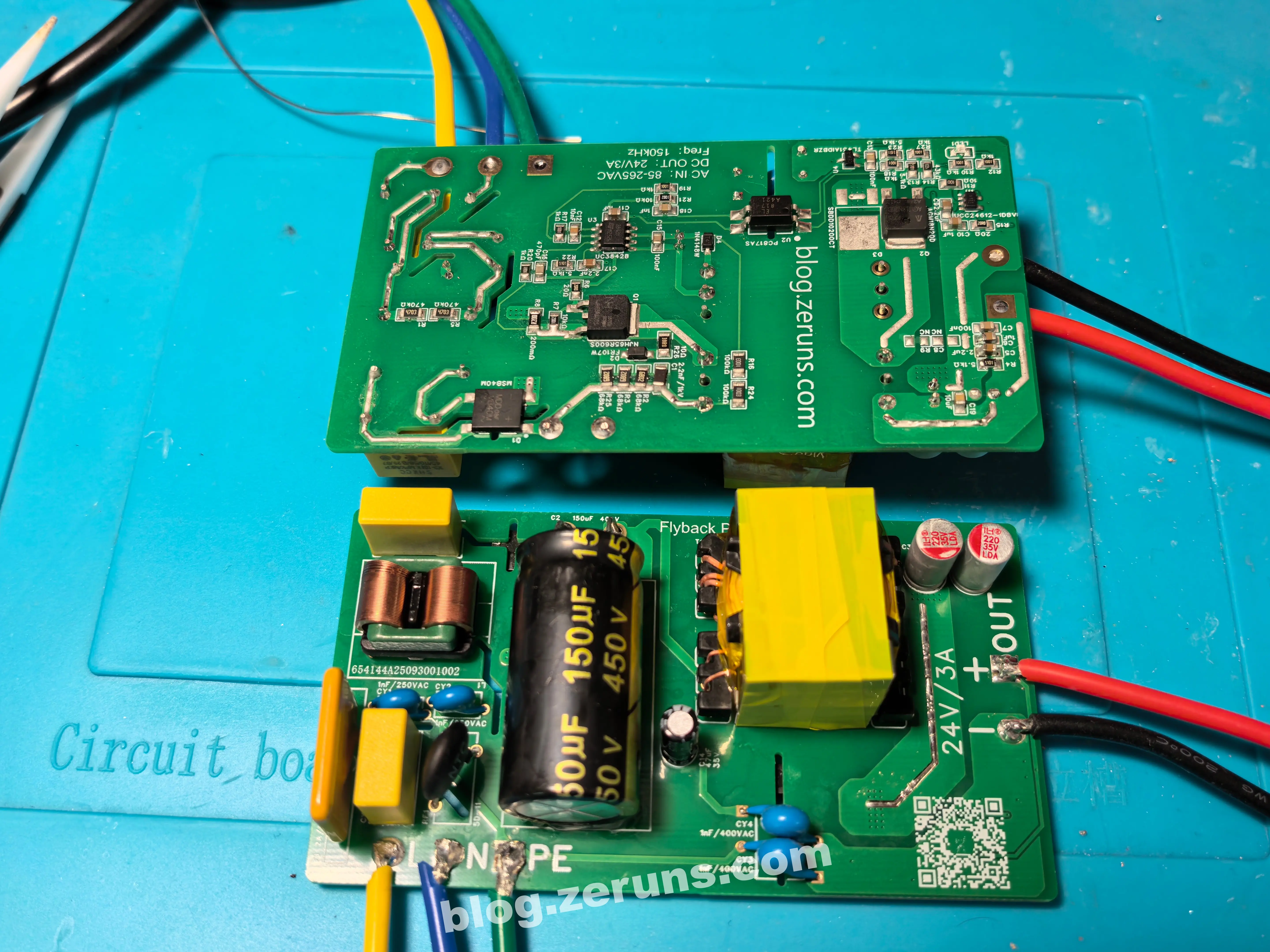
Open Source 24V3A Flyback Power Supply Based on UC3842, with Transformer Parameter Calculation
An open-source 24V 3A flyback switching power supply design for 85–265VAC input, achieving 87.4% peak efficiency. Based on UC3842 with synchronous rectification, it provides schematics, PCB files, transformer calculations and specifications, and PSIM simulation models. Test data shows 83–87% efficiency, 1.81W no-load consumption, and ripple around 560–730mV. Full-load thermal performance requires heatsinking.
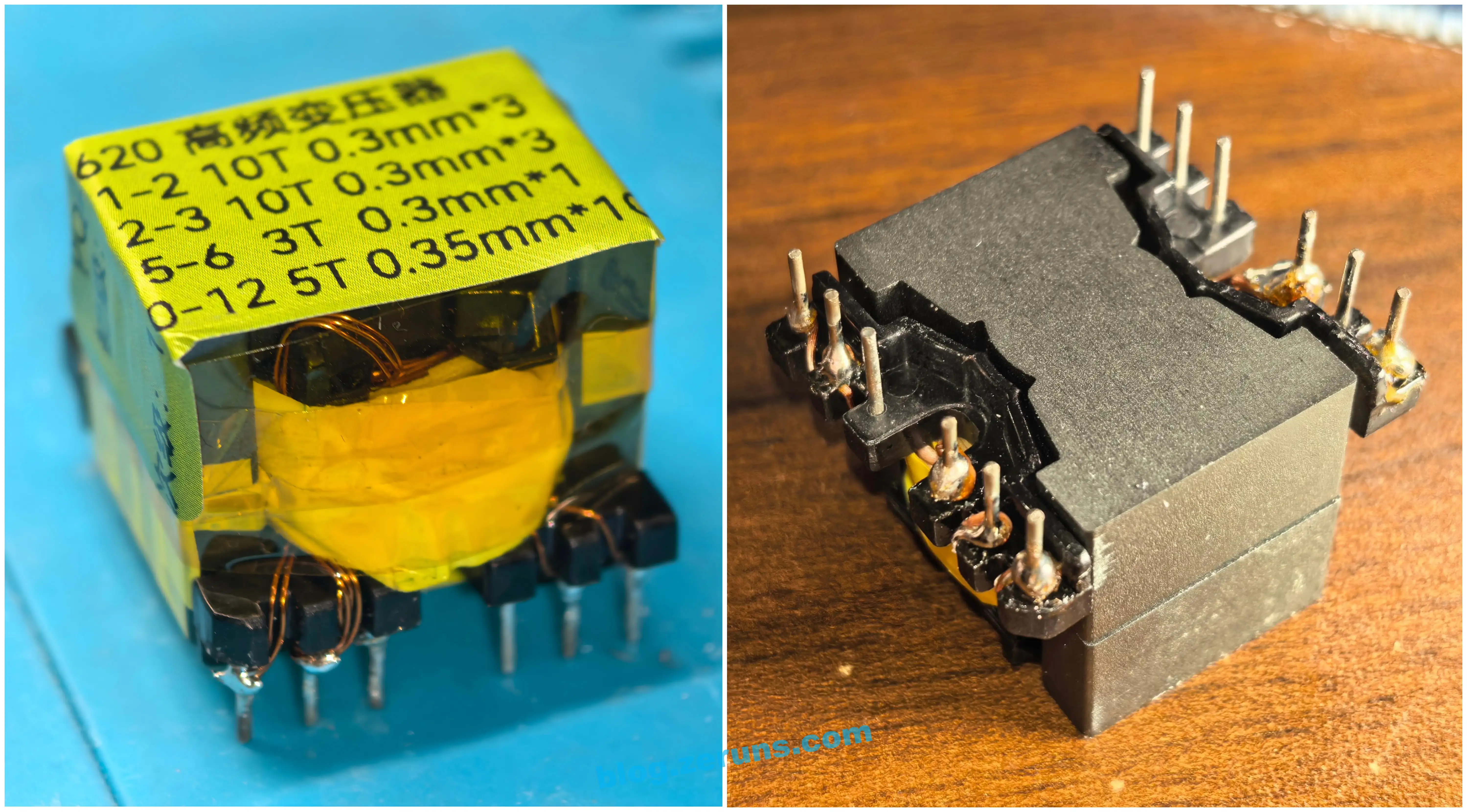
Flyback Power Supply Design: Parameter Calculation, Component Selection & Transformer Winding Guide
This article presents a complete design procedure for a 72W flyback switching power supply (24V/3A) with universal 85-265VAC input. It provides step-by-step calculations for rectifier bridge, input filter, transformer magnetizing inductance and turns, wire selection with skin effect, MOSFET and output diode ratings, output capacitor, and RCD snubber. Key trade-offs such as frequency vs. efficiency, flux density selection, and core AP value are explained. The article also details practical transformer winding, including air gap adjustment and leakage inductance measurement, enabling readers to replicate the design.
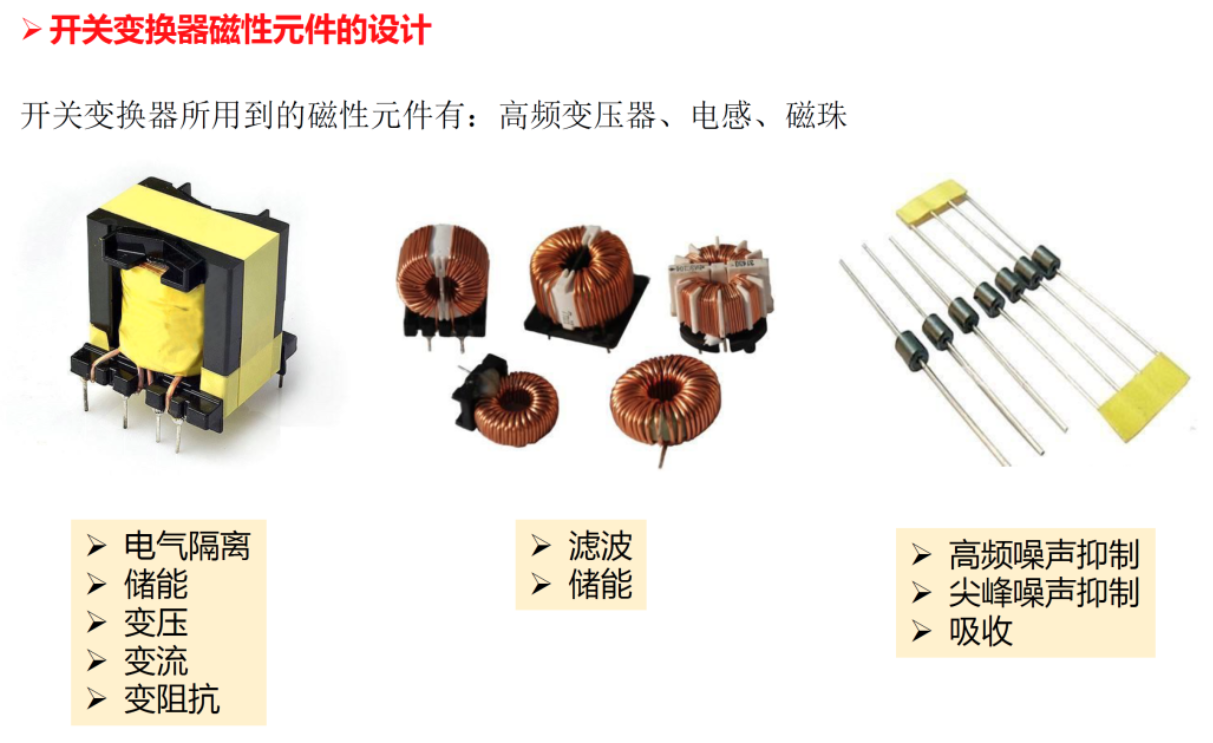
Magnetic Components/Magnetic Core Materials & Structures: Analysis, Comparison & Selection Guide
This article provides a systematic guide to magnetic core selection for power electronics, covering key parameters (permeability, saturation, core loss, Curie temperature), comparing materials like ferrite, sendust, permalloy, amorphous and nanocrystalline alloys, and reviewing core structures (EE, PQ, toroidal). It offers engineering recommendations for AC/DC, DC/DC, PFC, and inverter applications, emphasizing frequency matching, loss control, and cost balance. Engineers gain practical reference for choosing cores.