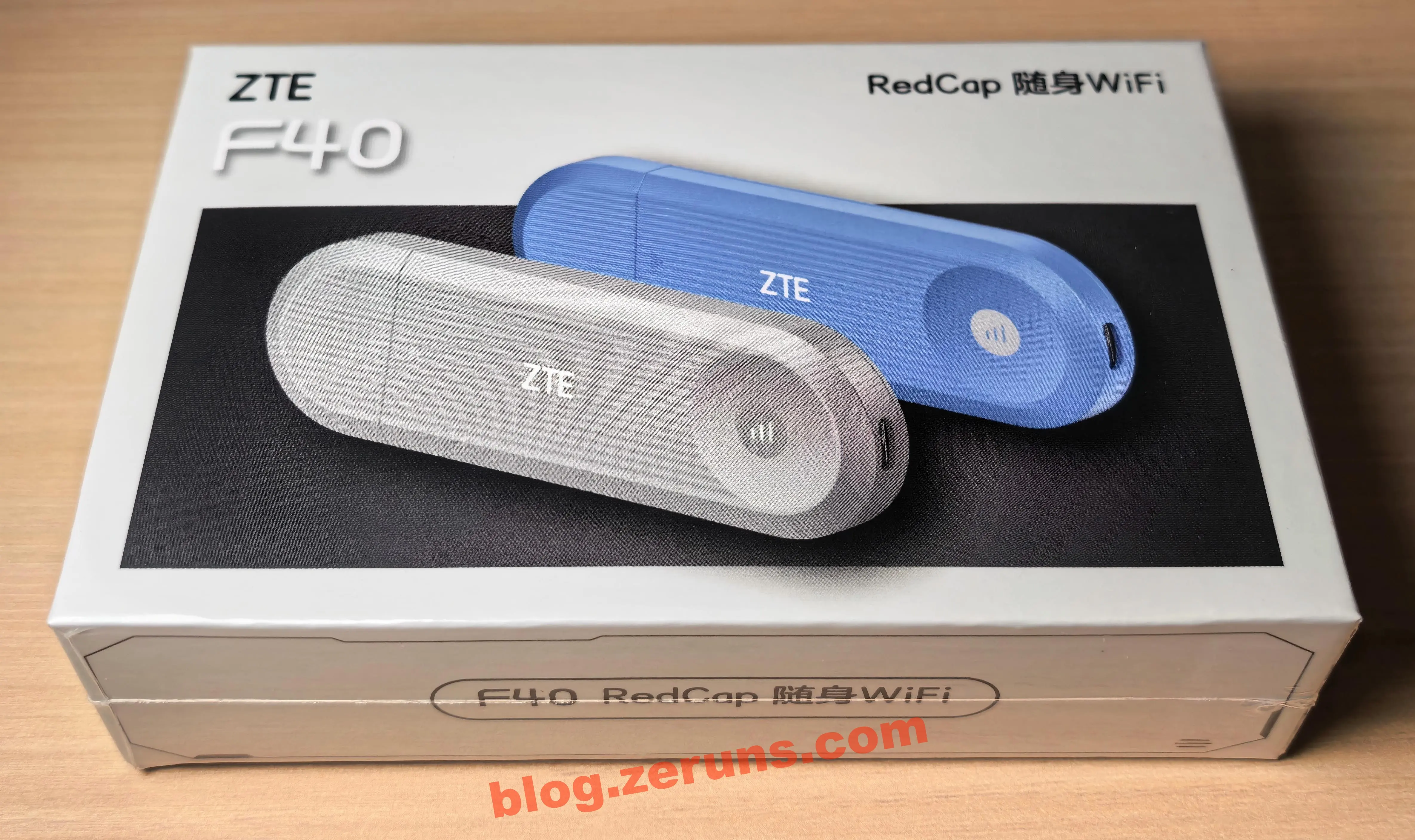
ZTE F40 5G RedCap Portable Wi-Fi - Quick Unboxing and Hands-on Review
I purchased this portable Wi-Fi to replace my Huawei 4G hotspot, which has been in service for nearly 10 years.
Introduction
Product Overview
The ZTE F40 is a 5G RedCap (Reduced Capability) lightweight portable Wi-Fi device launched by ZTE on January 13, 2026. Featuring a compact "USB flash drive" design, it focuses on cost-effectiveness and low power consumption. It is available in two versions: a dual-network version (built-in eSIM) and a SIM card version (supporting a physical nano-SIM).
Specifications
| Category | Parameter | Details |
|---|---|---|
| Mobile Network | Wireless Bands | 5G: n1/3/5/8/28/41/78 | 4G: B1/3/5/8/28/34/38/39/40/41 |
| WLAN Features | Wireless Standards | IEEE 802.11a/b/g/n/ac/ax (Wi-Fi 6) |
| WLAN Features | Supported Bands | 2.4GHz or 5GHz (1×1) |
| WLAN Features | Max Connections | 16 devices |
| Interfaces | Interface Type | Dual Interface: USB-A & USB-C |
| Physical Specs | Dimensions | 104mm × 34mm × 11mm |
| Physical Specs | Weight | Approx. 34g |
| Package Contents | Standard Items | F40 Unit ×1, Activation Insert ×1 |
This product features built-in 5G dual-network support (China Mobile + China Telecom). By utilizing 5G RedCap technology, it reduces power consumption by 10-20% compared to full-featured 5G, while offering a 50% speed increase and 70% lower latency compared to 4G.
The ZTE F40 supports dual-band Wi-Fi 6, allows up to 16 simultaneous connections, and provides dual USB interfaces. It supports both USB direct-tethering and Wi-Fi modes, and includes visual indicators to easily check the current network provider status.
Where to Buy
- JD.com: https://u.jd.com/jDz1ebu
- Taobao: https://s.click.taobao.com/Ob209Ym
- Pinduoduo: https://p.pinduoduo.com/dJC3TYWs?sc=EFAC
What is 5G RedCap? The "Lite" Version of 5G
5G RedCap (Short for Reduced Capability) is a streamlined version of 5G introduced by 3GPP in the Release 17 (R17) standard. Often referred to as "Little Red Cap," it is positioned between traditional 5G eMBB (Enhanced Mobile Broadband) and low-rate mMTC (Massive Machine-Type Communications). It is specifically designed for scenarios requiring medium-to-high speeds, low cost, and low power consumption.
Key Technical Characteristics
RedCap achieves an "ideal balance" through precise capability pruning:
- Bandwidth Reduction: For Sub-6GHz bands, the bandwidth is reduced from the full 5G 100MHz to 20MHz, lowering hardware complexity.
- Antenna Simplification: Reduced from 4T4R to 1T1R or 1T2R, minimizing RF links and power draw.
- Modulation Downgrade: Uses 64QAM as the standard (Full 5G supports 256QAM), reducing processing pressure on the terminal.
- Protocol Optimization: Simplified control channel design leads to shorter connection times and better standby efficiency.
Comparison: RedCap vs. Full 5G (Mobile Wi-Fi Focus)
| Comparison Metric | 5G RedCap | Full 5G (Flagship Phone) | Impact on Portable Wi-Fi |
|---|---|---|---|
| Peak Rates | DL ~150Mbps, UL ~50Mbps | DL 1-10Gbps, UL 500Mbps+ | Sufficient for web browsing, video, and light office work; doesn't support 8K streaming. |
| Max Bandwidth | Sub-6GHz: 20MHz | Sub-6GHz: 100MHz, mmWave: 200MHz | Reduces costs by 30%-50%; makes devices more compact. |
| Antenna Config | 1T1R/1T2R | 4T4R/8T8R | Reduces power consumption by ~40%; extends battery life. |
| Supported Bands | Sub-6GHz only (Mainstream) | Sub-6GHz + mmWave | Comprehensive coverage without mmWave compatibility issues. |
| Device Cost | Significantly lower (Module ~$15) | High (Flagship chips ~$150+) | Drives portable Wi-Fi prices below $30 (200 RMB). |
Why it's Perfect for Portable Wi-Fi
RedCap is the "just right" technology choice for mobile hotspots:
- Cost Advantage: Drastically lower module prices translate to cheaper retail units, turning 5G hotspots from luxury items into mass-market products.
- Power Efficiency: Maintains hundred-megabit speeds while significantly reducing battery drain and charging frequency.
- Adequate Experience: A 150Mbps downlink is plenty for 4K video, online gaming, and remote work, with negligible difference from full 5G in real-world daily use.
- Strong Compatibility: Supports core 5G features like network slicing and low latency, while remaining backward compatible with 4G to ensure continuous coverage.
Future Outlook
Beyond portable Wi-Fi, RedCap is widely applicable to video surveillance, industrial sensors, wearables, and telematics. It is a key technology for the large-scale adoption of 5G. As the R18 standard matures, RedCap speeds will improve further while maintaining cost advantages, enabling more smart devices to join the 5G ecosystem.
Unboxing
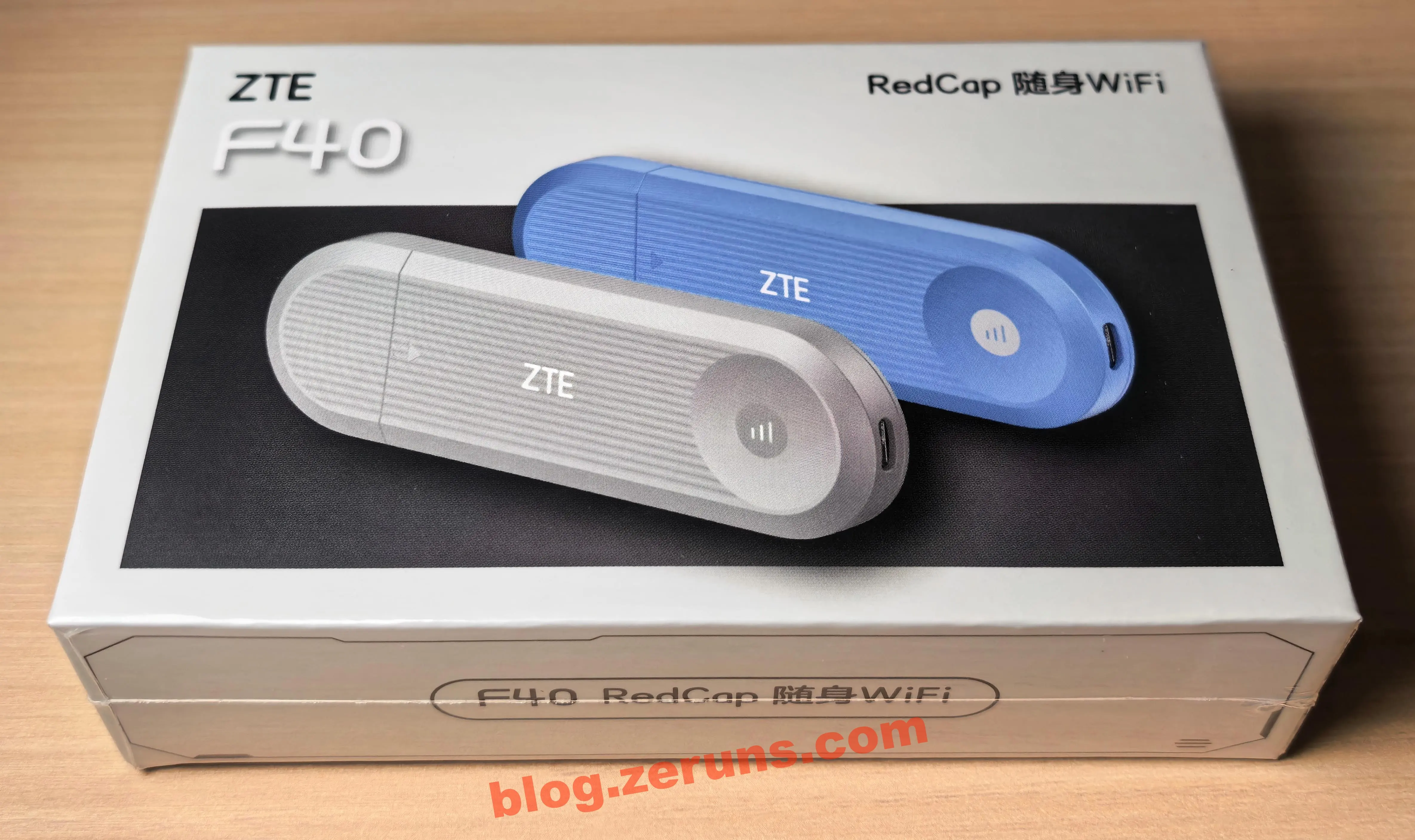
Packaging Front View
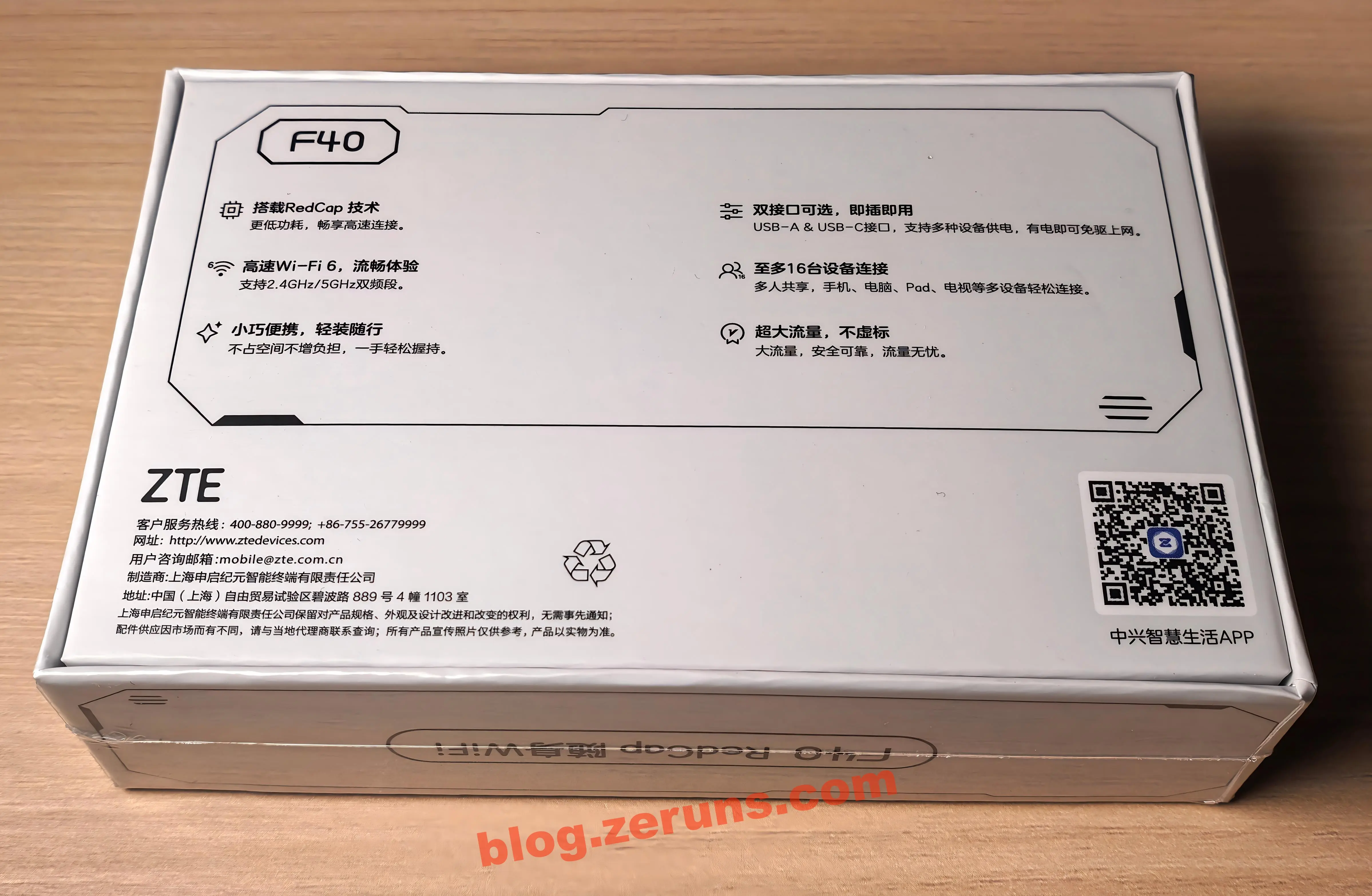
Packaging Back View
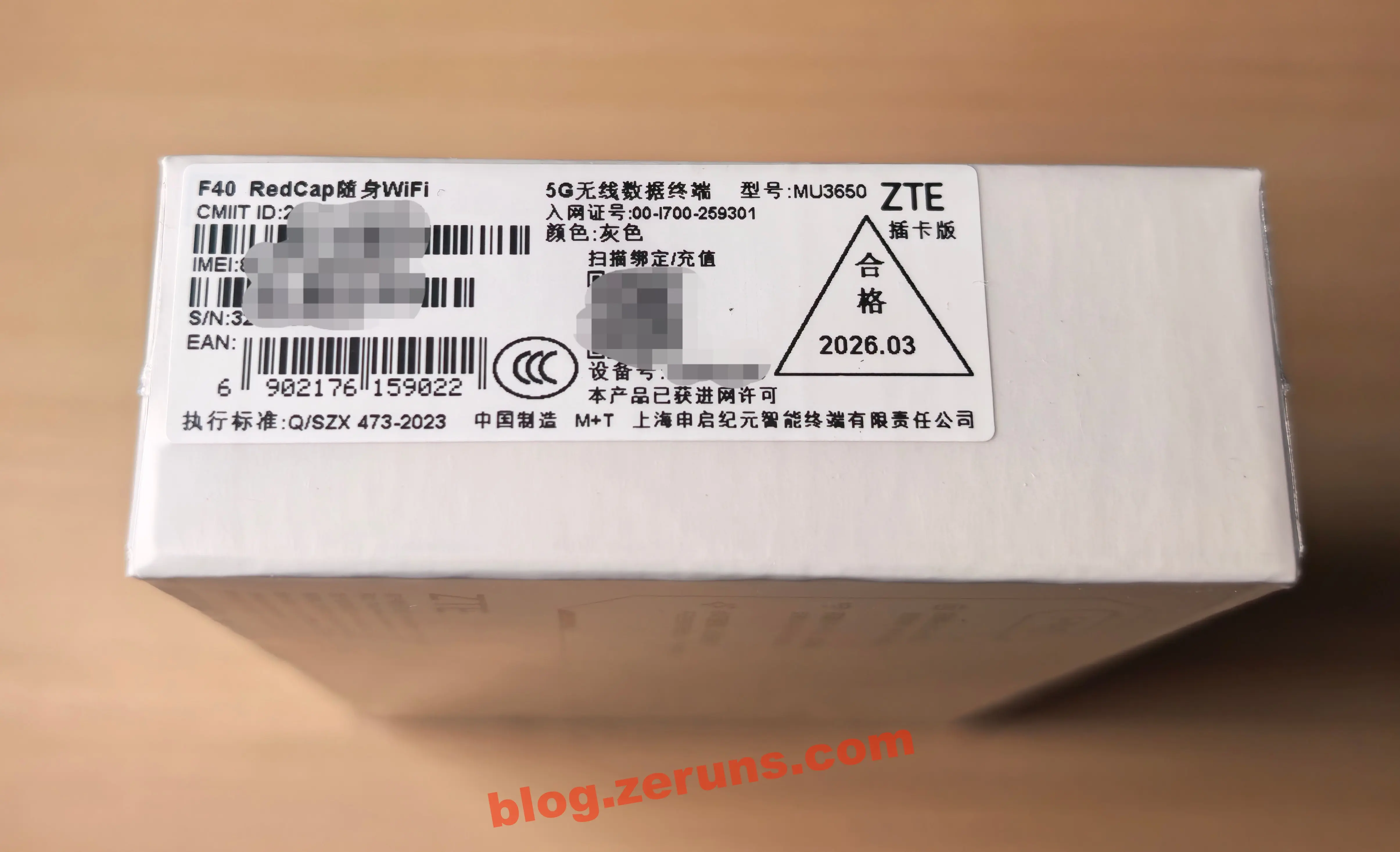
Packaging side showing device info: 5G Wireless Data Terminal, Model MU3650. Includes CMIIT ID, IMEI, SN, and the Device Number (used for binding the device on the ZTE Portable Wi-Fi WeChat official account for topping up the built-in IoT card).
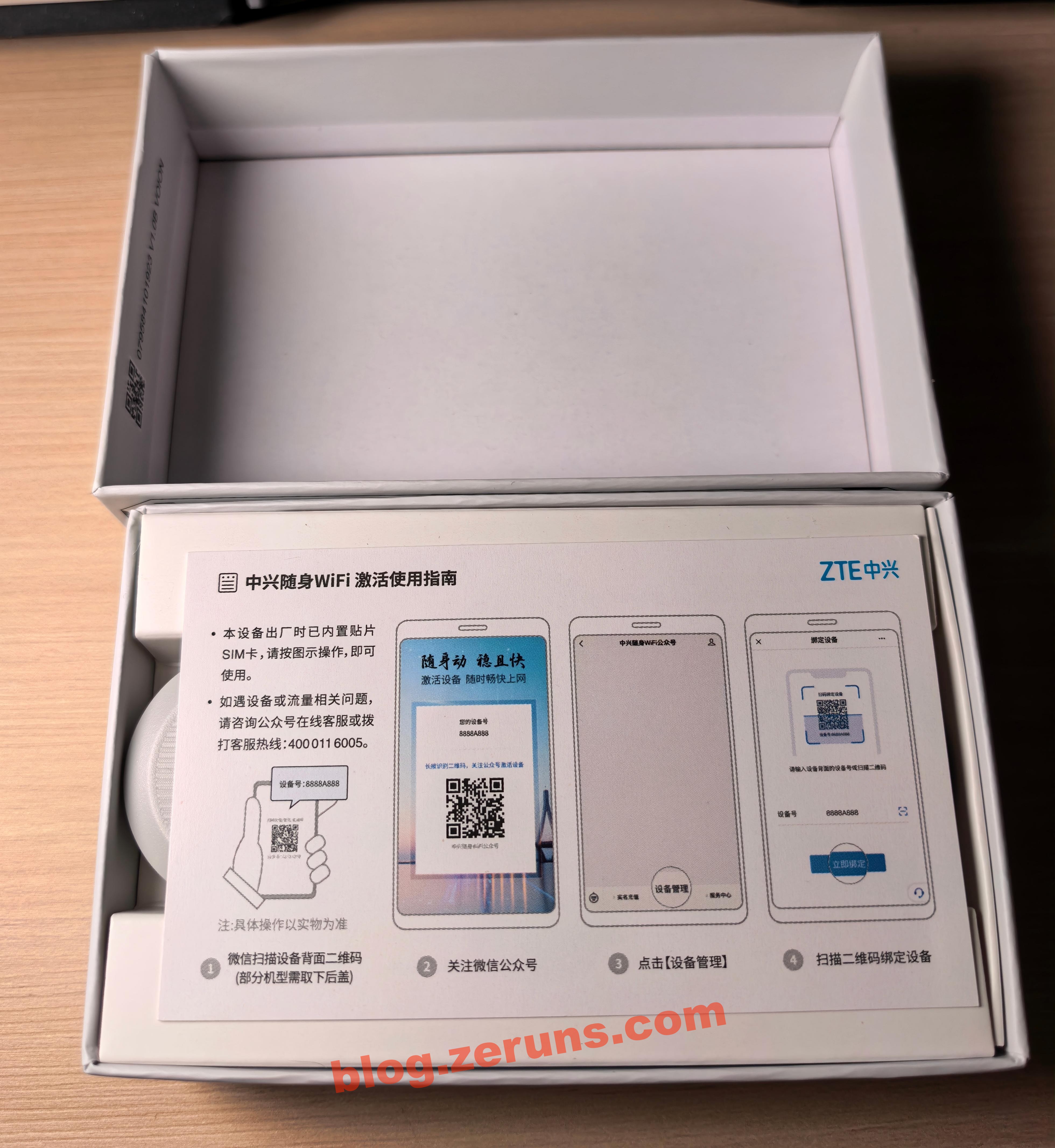
Inside the box is a quick-start guide.
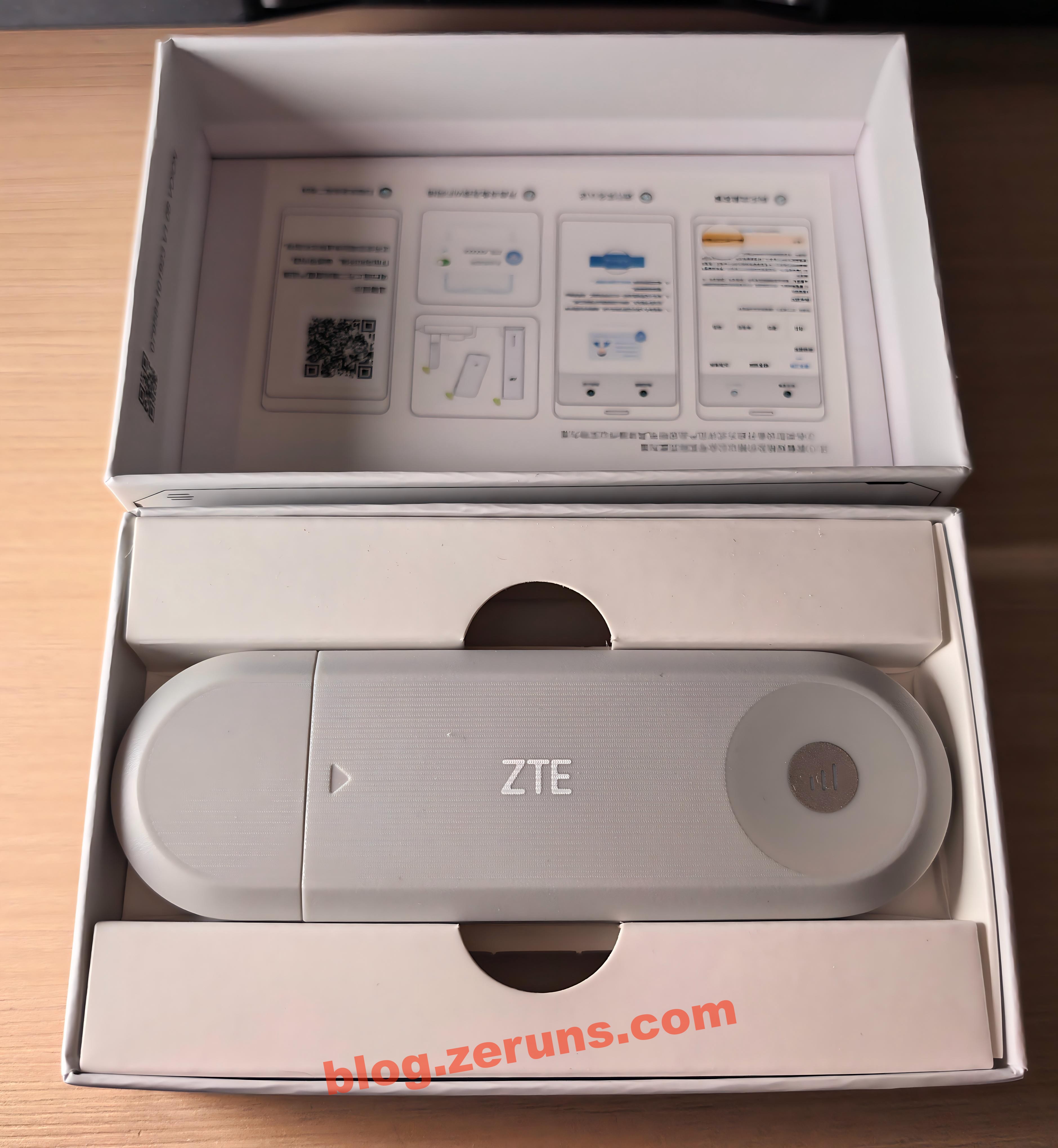
The ZTE F40 itself looks like an oversized USB drive with rounded ends.
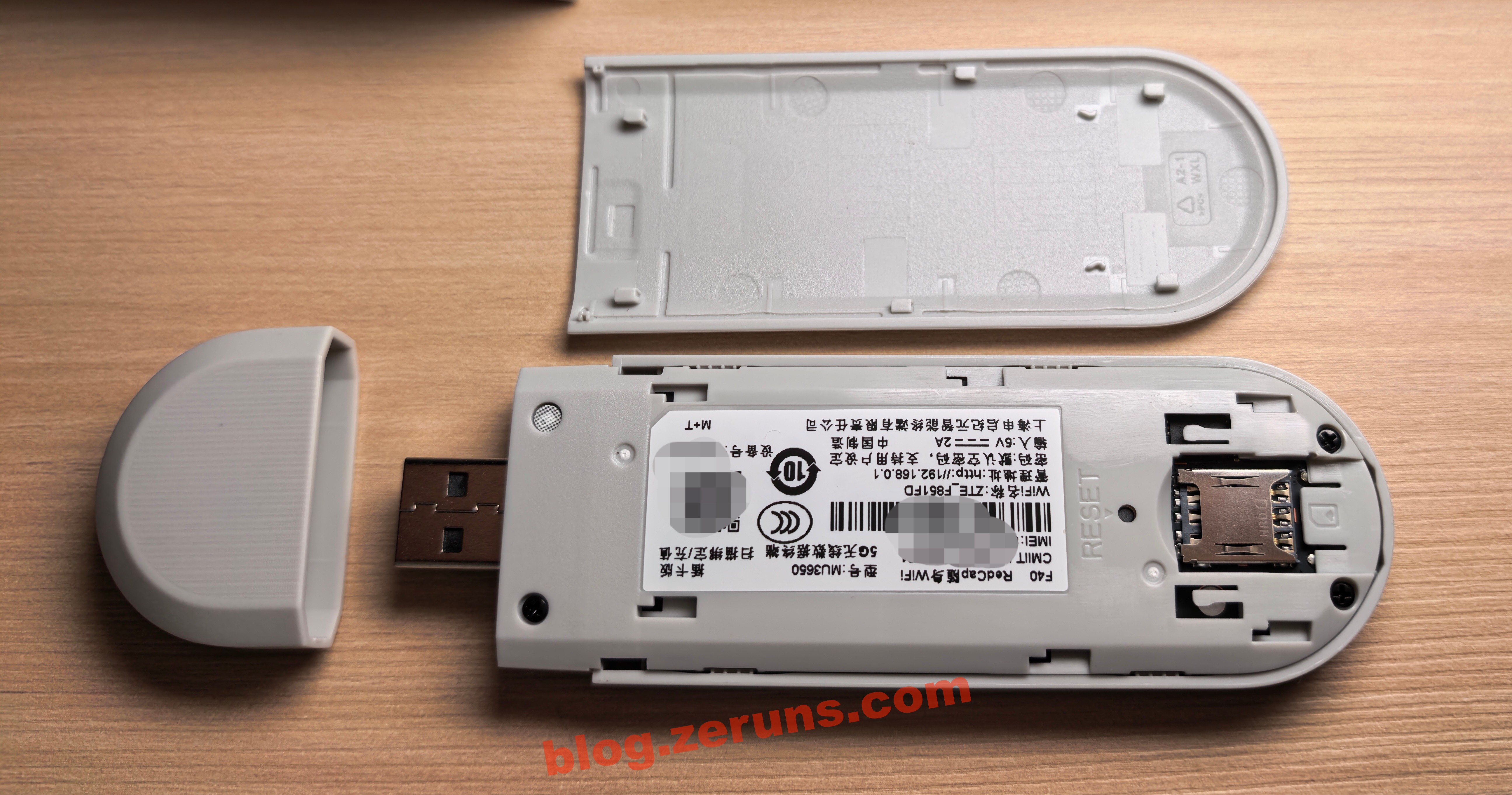
Removing the cap reveals a nano-SIM slot, a reset button, and a label with device details.
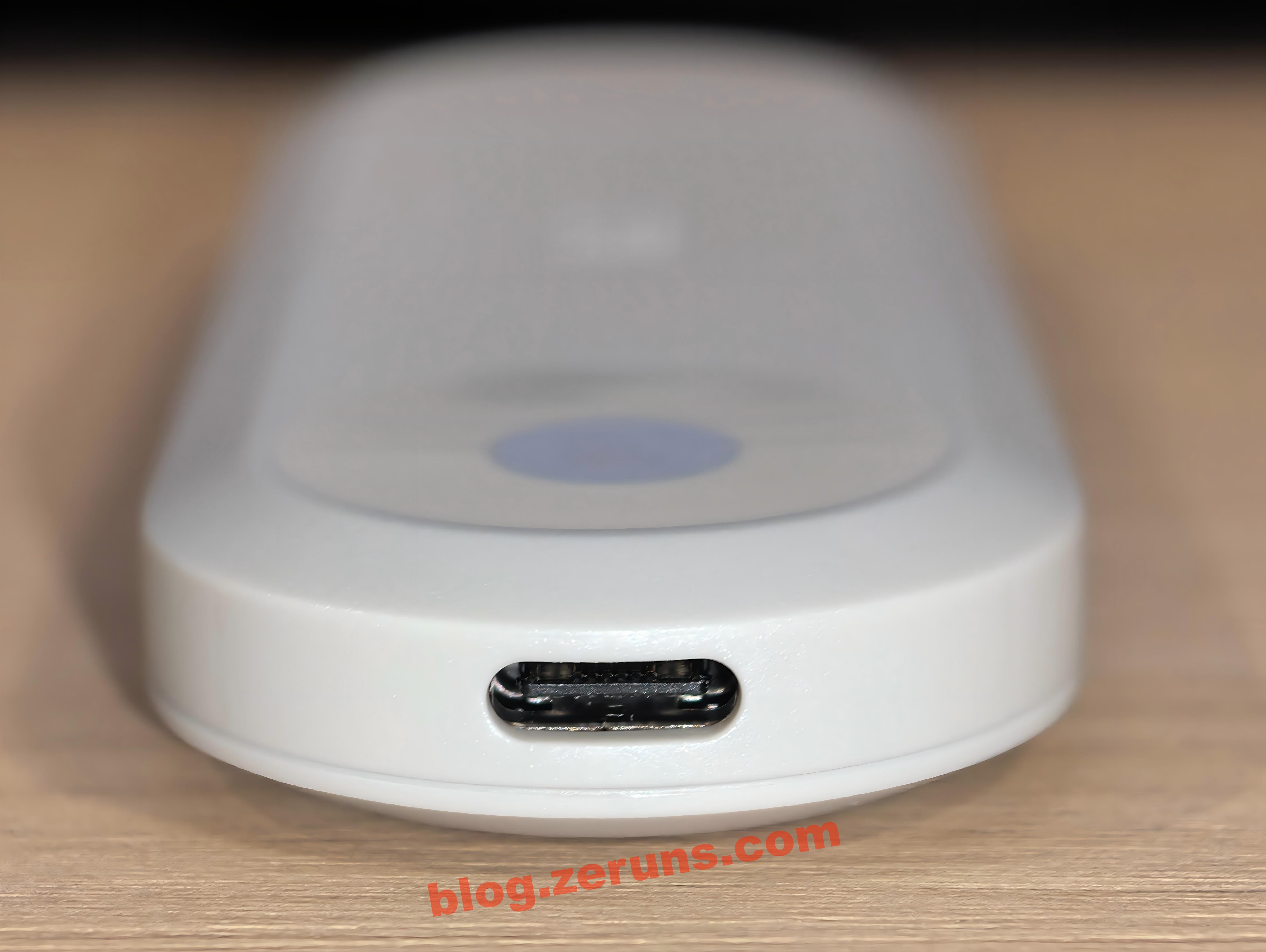
In addition to the USB-A connector, there is a Type-C port on the other side, which can also be used for power and data.
Performance Testing
Network Speed Tests
Location: A room in a technology park, Guangming District, Shenzhen.
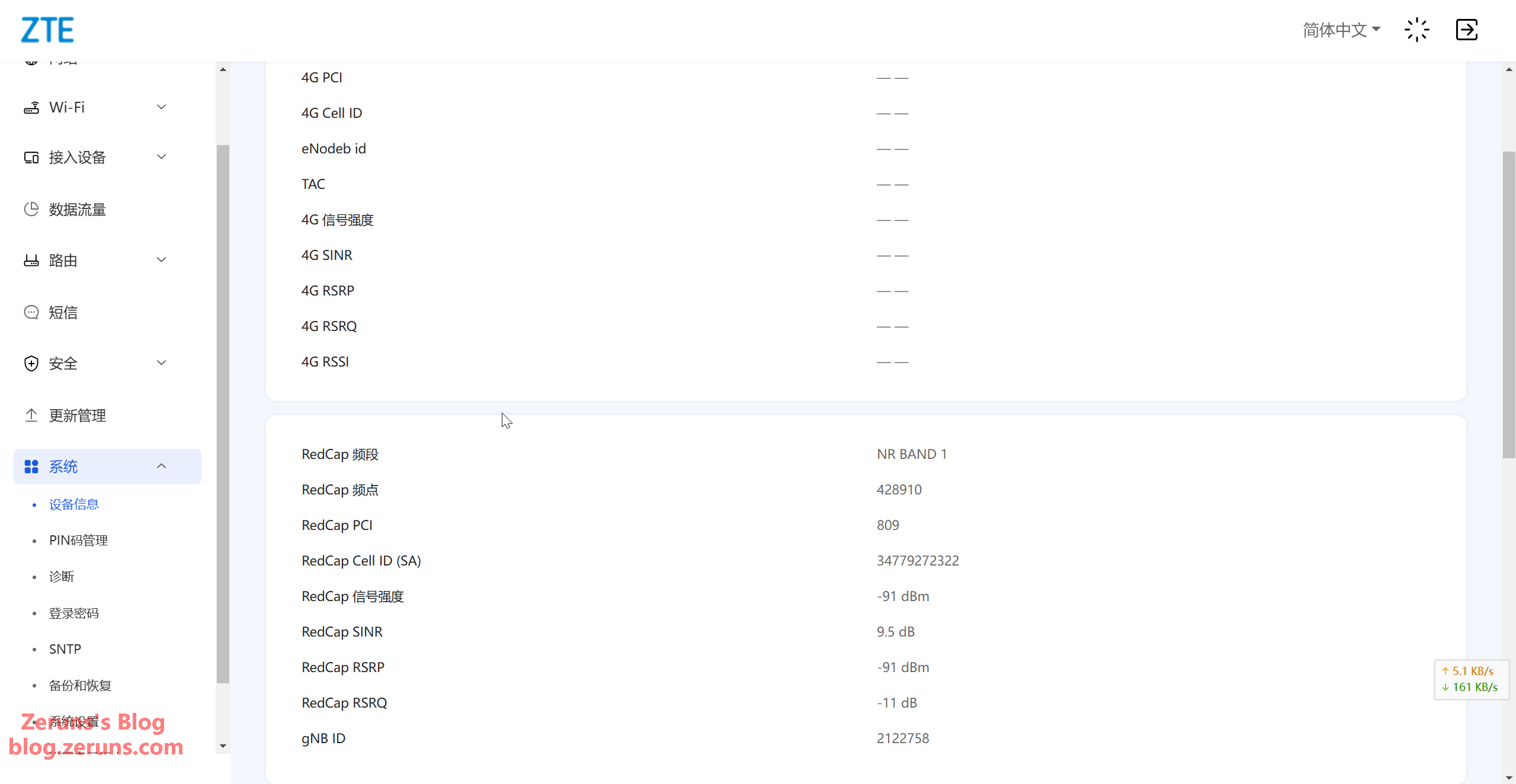
China Telecom 5G
Network info as shown: Signal strength -91dBm, Band NR n1 (2.1GHz). The signal is relatively weak.
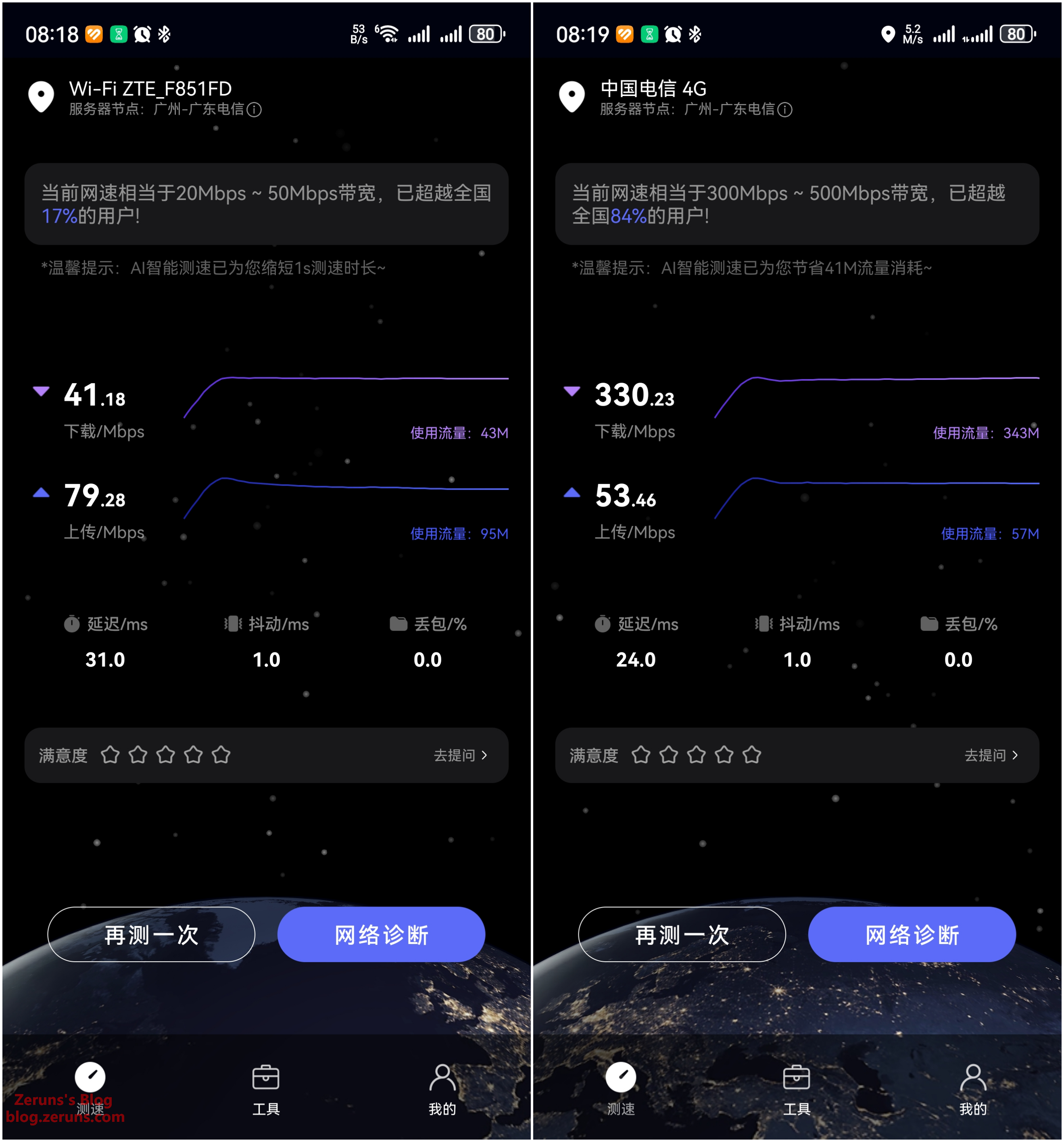
Left: F40 Portable Wi-Fi — Download 41Mbps, Upload 79Mbps.
Right: Huawei Mate 70 Pro+ — Download 330Mbps, Upload 53Mbps.
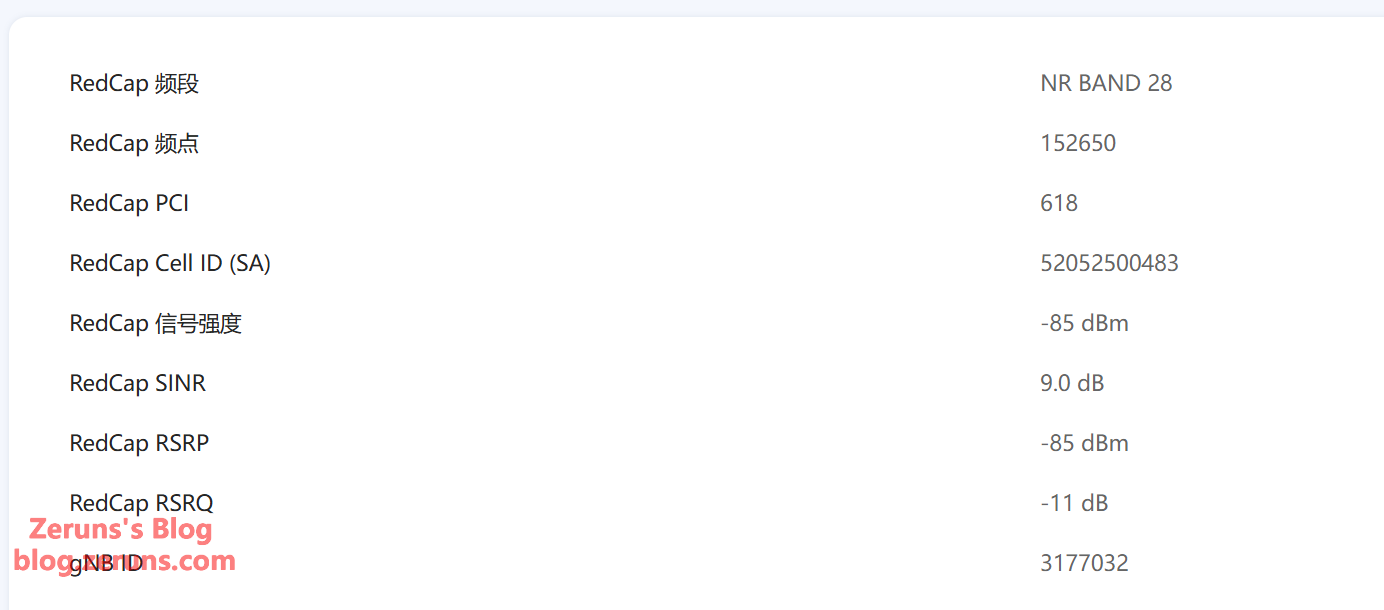
China Mobile 5G
Network info: Signal strength -85dBm, Band NR n28 (700MHz). Signal is average.
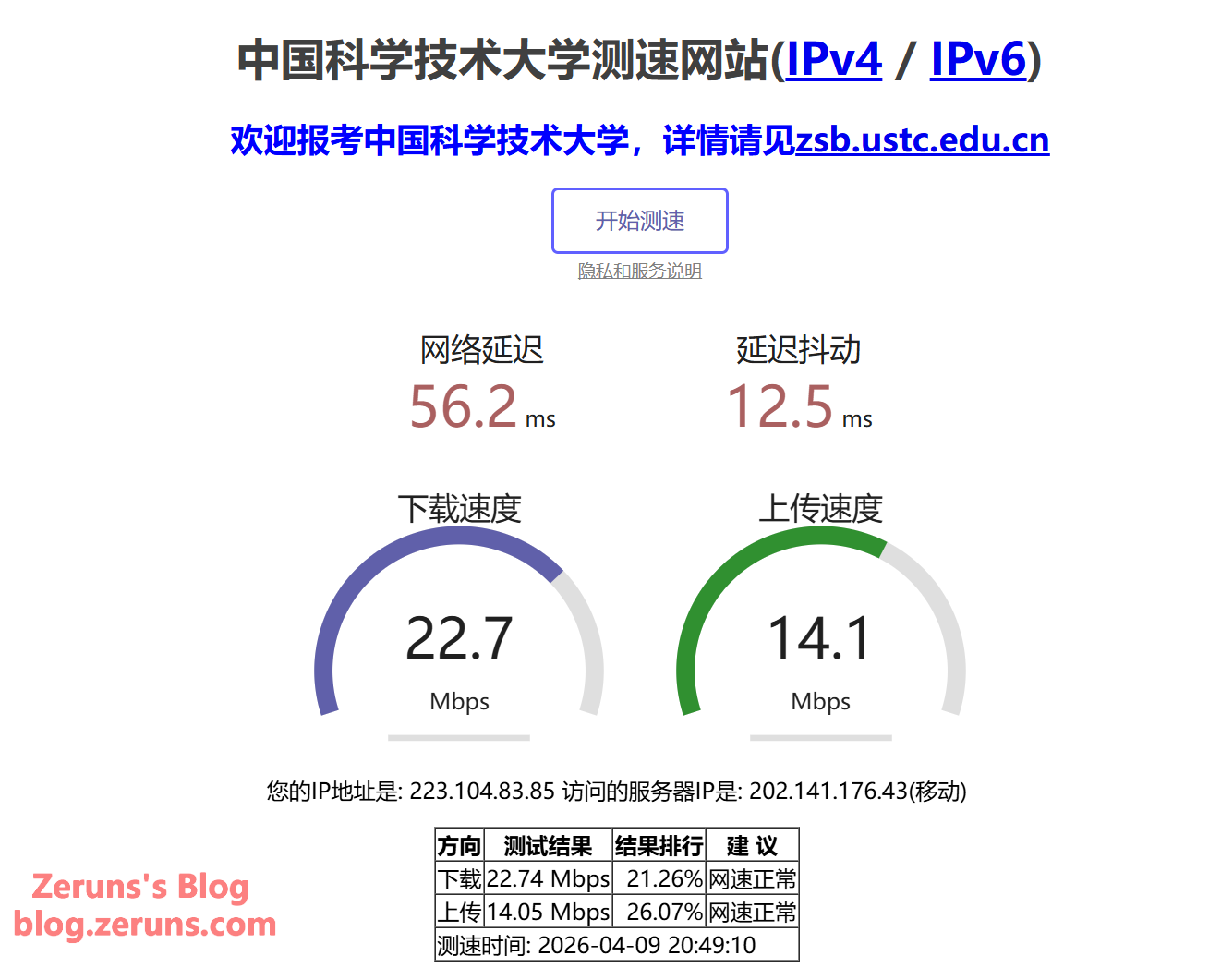
Mobile 5G (tested via USTC speed test): Download 22.7Mbps, Upload 14.1Mbps.
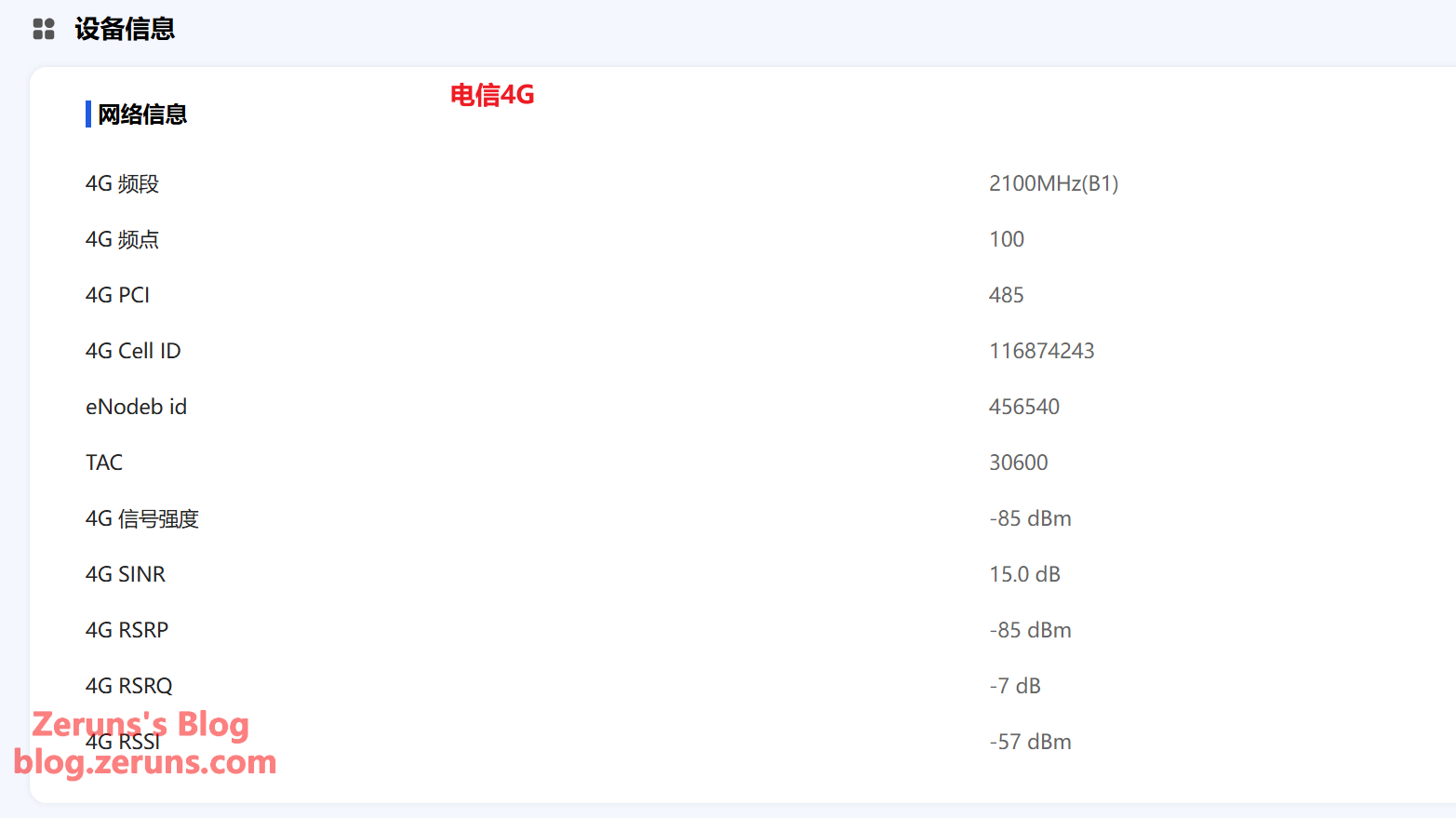
China Telecom 4G
Network info: Signal strength -85dBm, Band B1 (2100MHz). Signal is average.
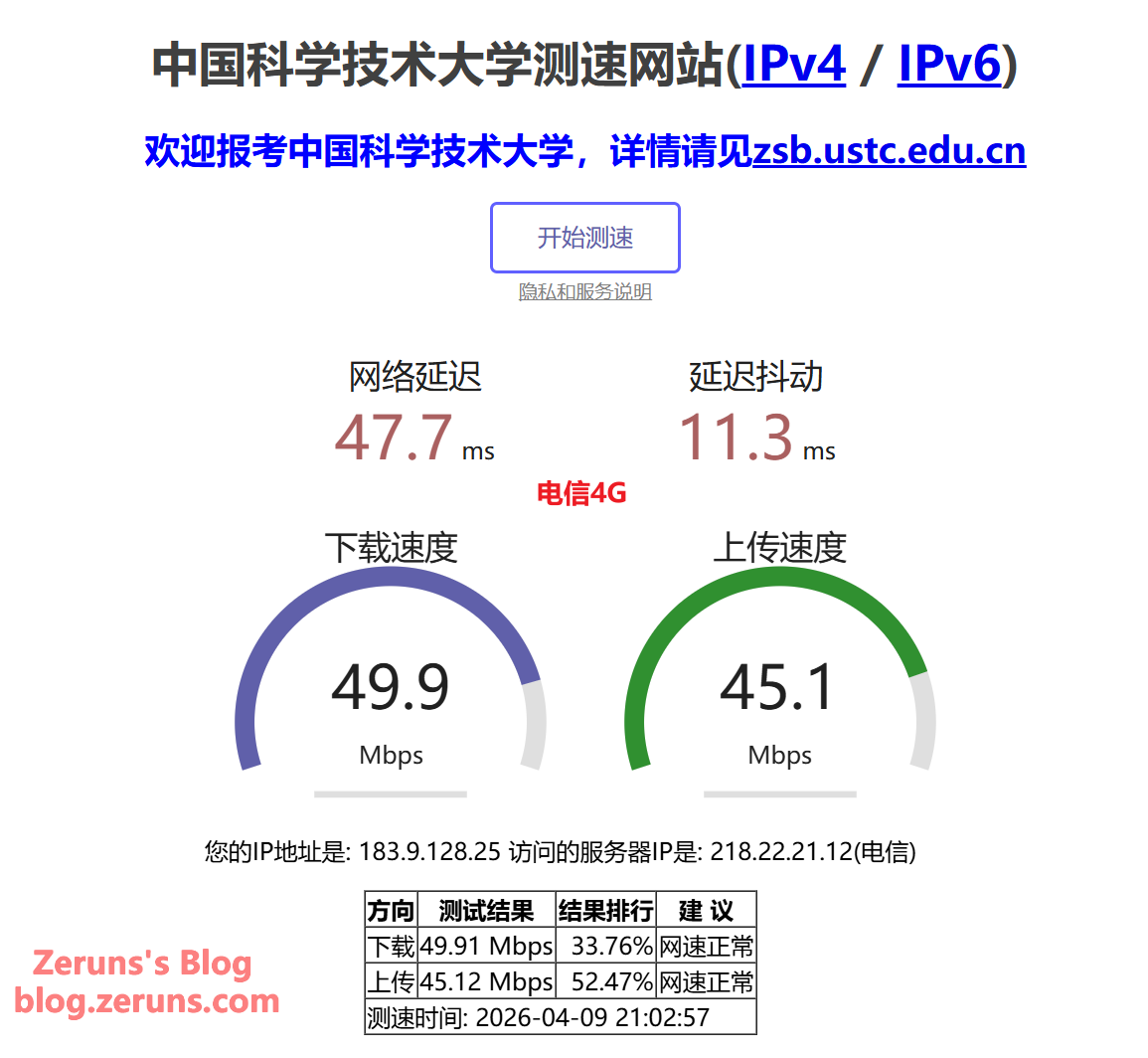
Telecom 4G (USTC test): Download 49.9Mbps, Upload 45.1Mbps.
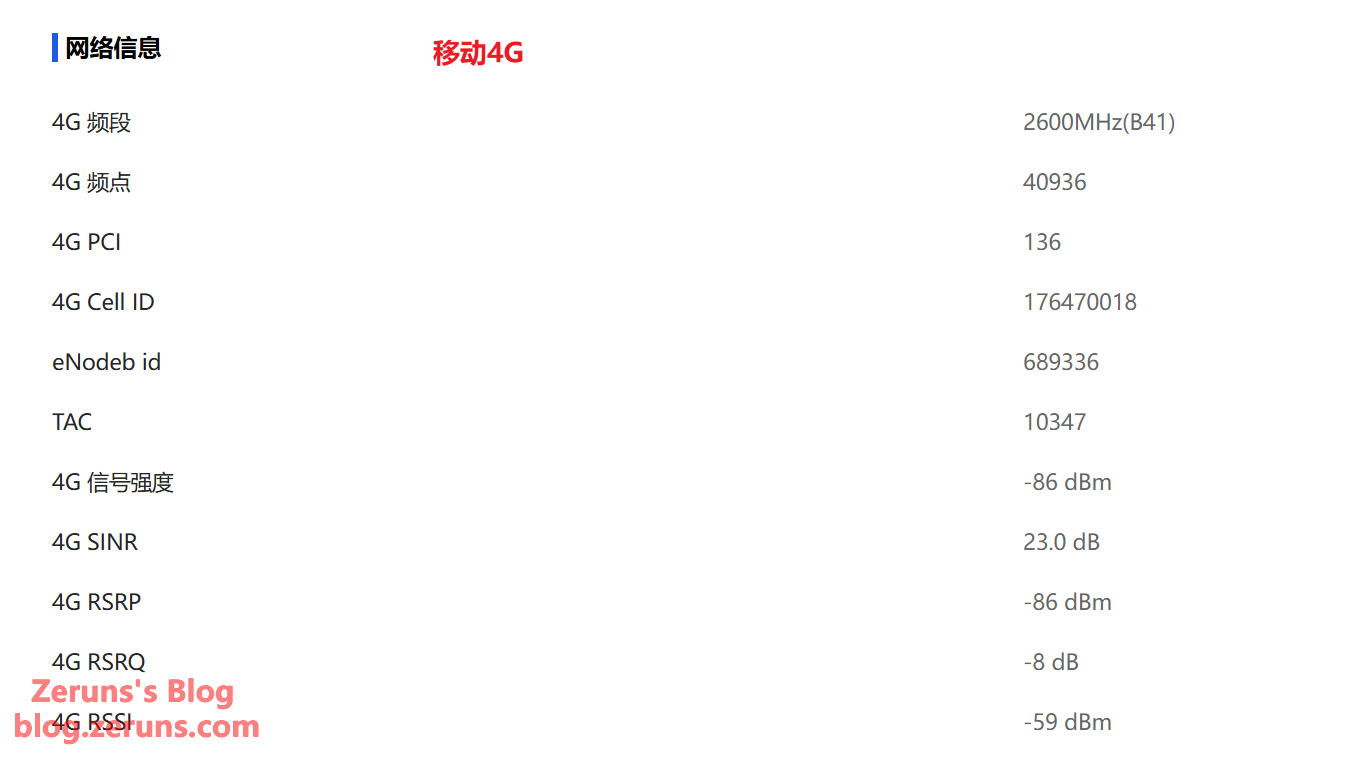
China Mobile 4G
Network info: Signal strength -86dBm, Band B41 (2600MHz). Signal is average.
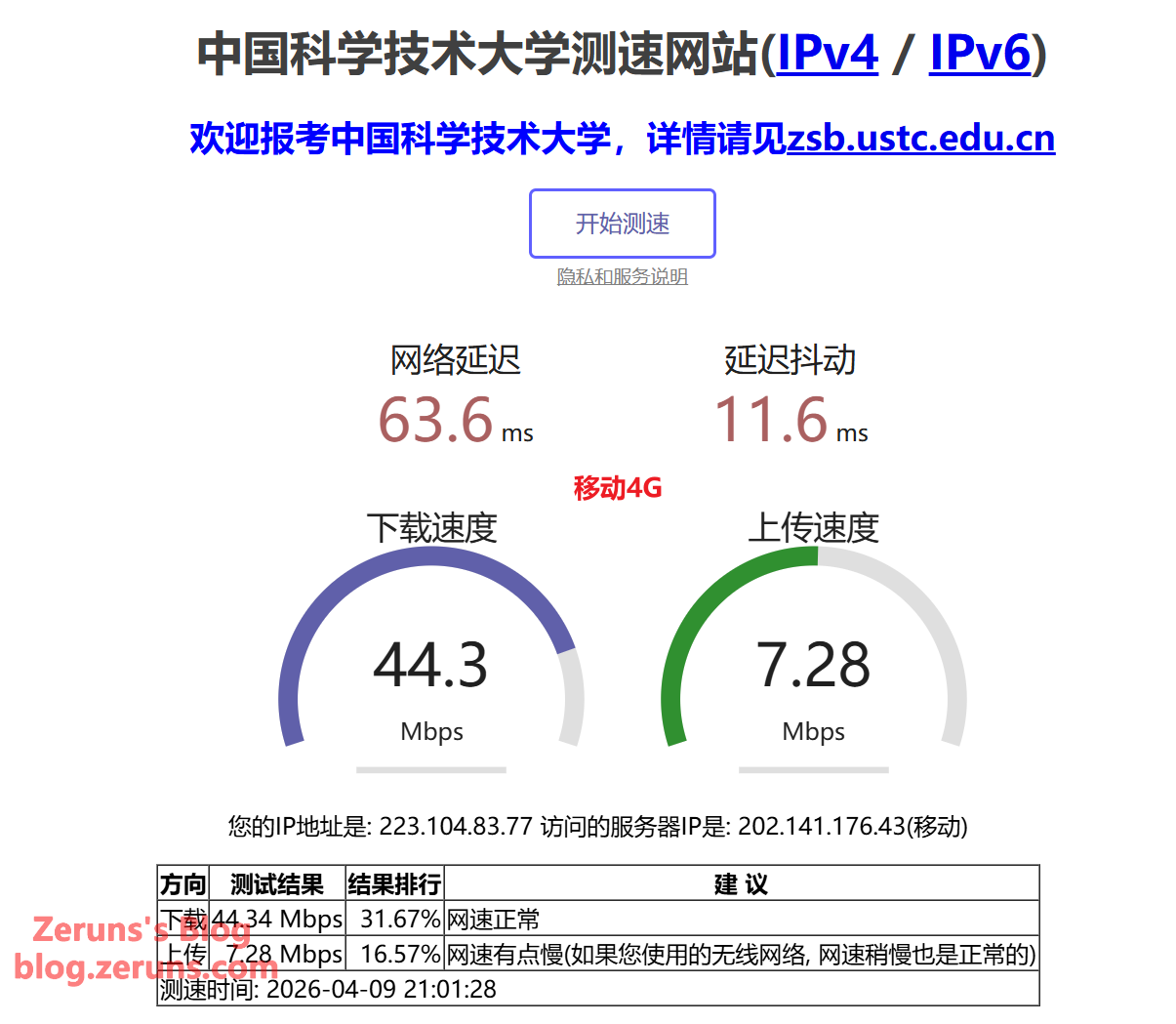
Mobile 4G (USTC test): Download 44.3Mbps, Upload 7.28Mbps.
Maximum Wi-Fi Rate
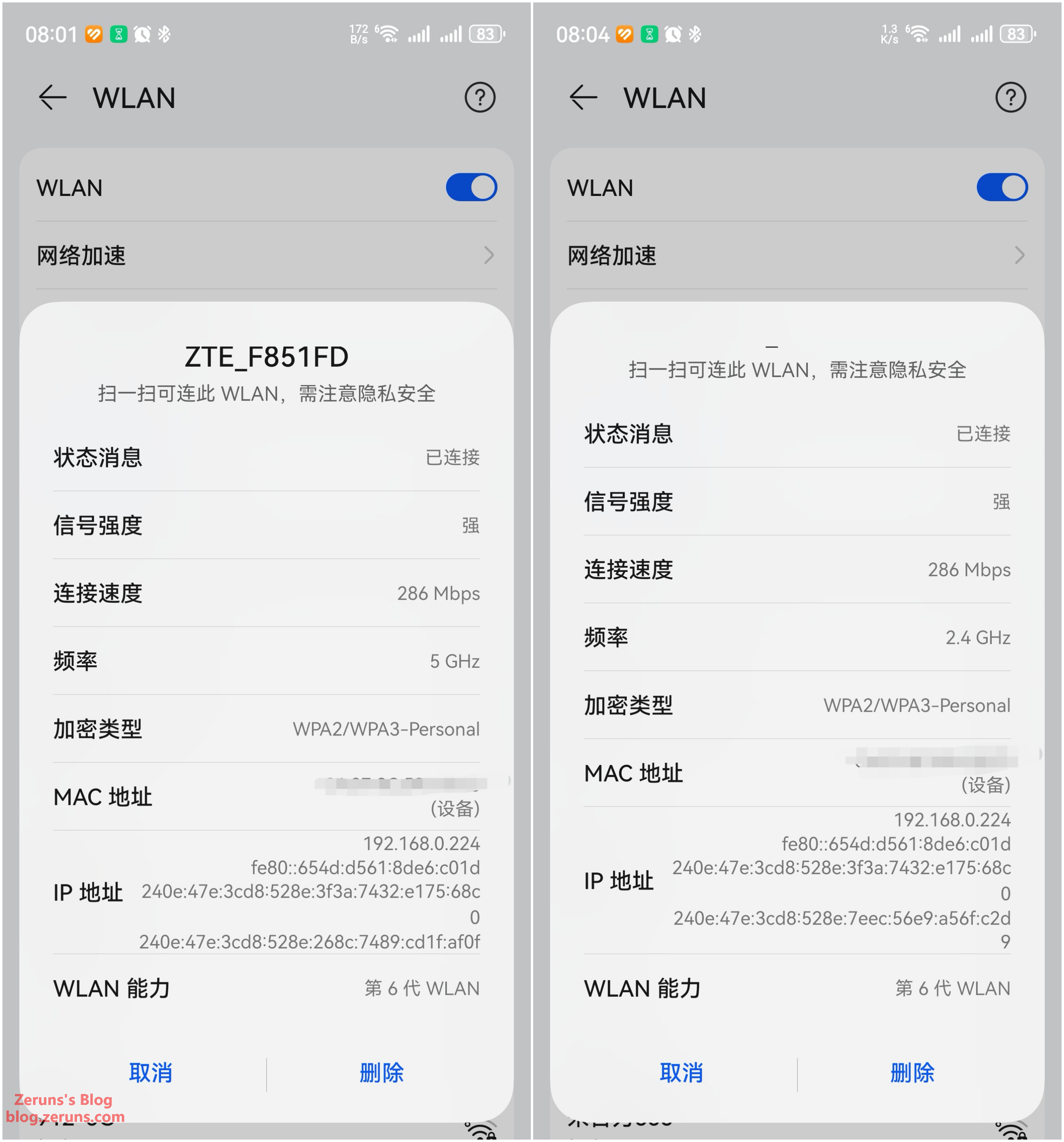
The theoretical Wi-Fi negotiation rate for both 2.4GHz and 5GHz is around 286Mbps. Note that both bands cannot be used simultaneously; you must choose one.
Power Consumption Test
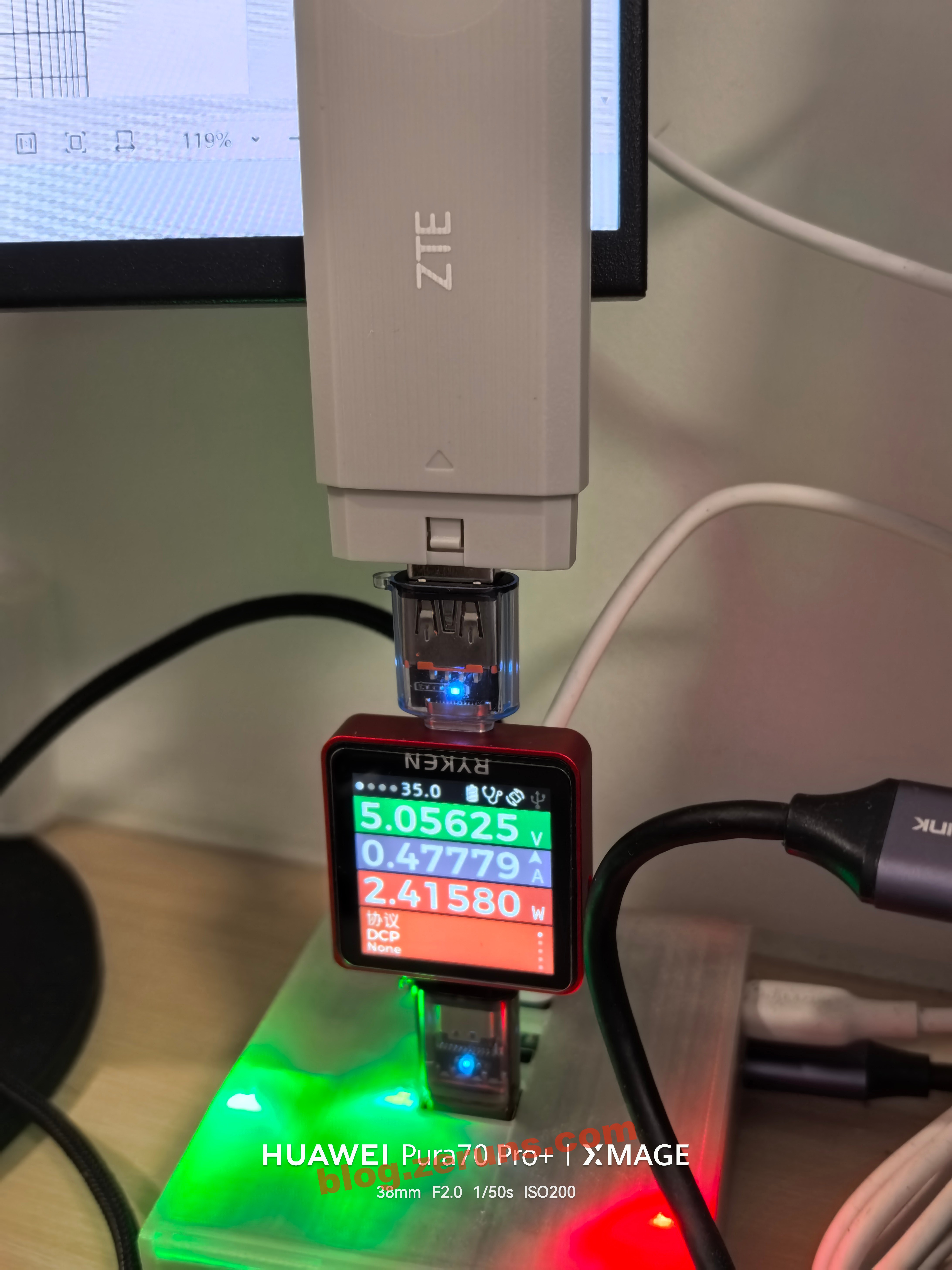
Switched to Telecom 5G with one device connected: Idle power is about 0.9W. Under load (speed testing), it reaches about 2.4W. The power consumption is indeed very low.
Data Pricing
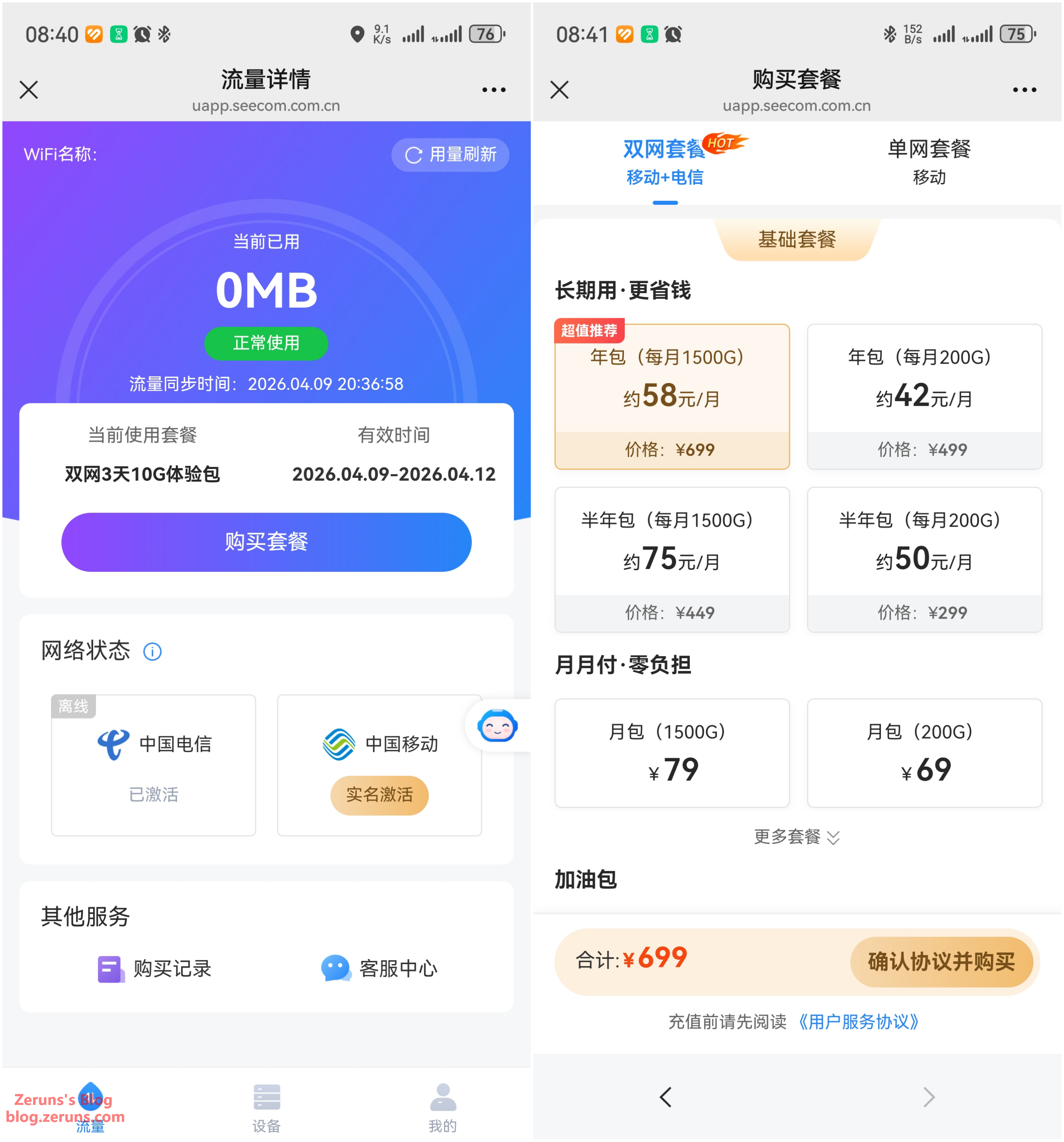
The version I purchased has two built-in eSIMs (Telecom and Mobile) and an extra physical SIM slot. The two built-in cards share the same data plan and can be toggled freely, which is very convenient.
The plan provides 1.5TB per month:
- Annual package: 699 RMB (~58 RMB/month)
- Monthly package: 79 RMB/month
The price is quite reasonable (considering my current 300Mbps home broadband costs 100 RMB/month).
Admin Web Interface
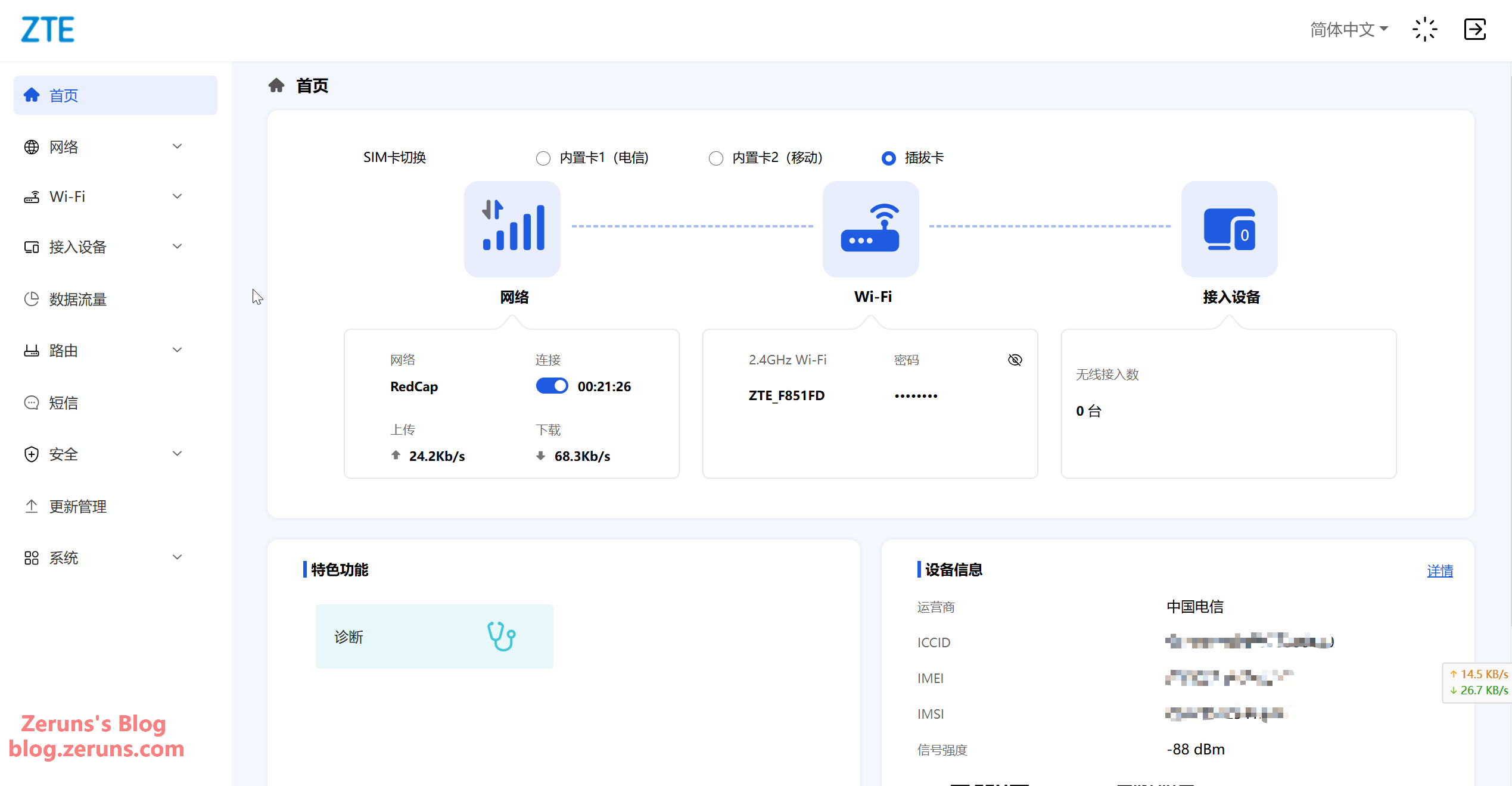
Home Page: Displays basic device and network info, allowing for quick SIM switching.
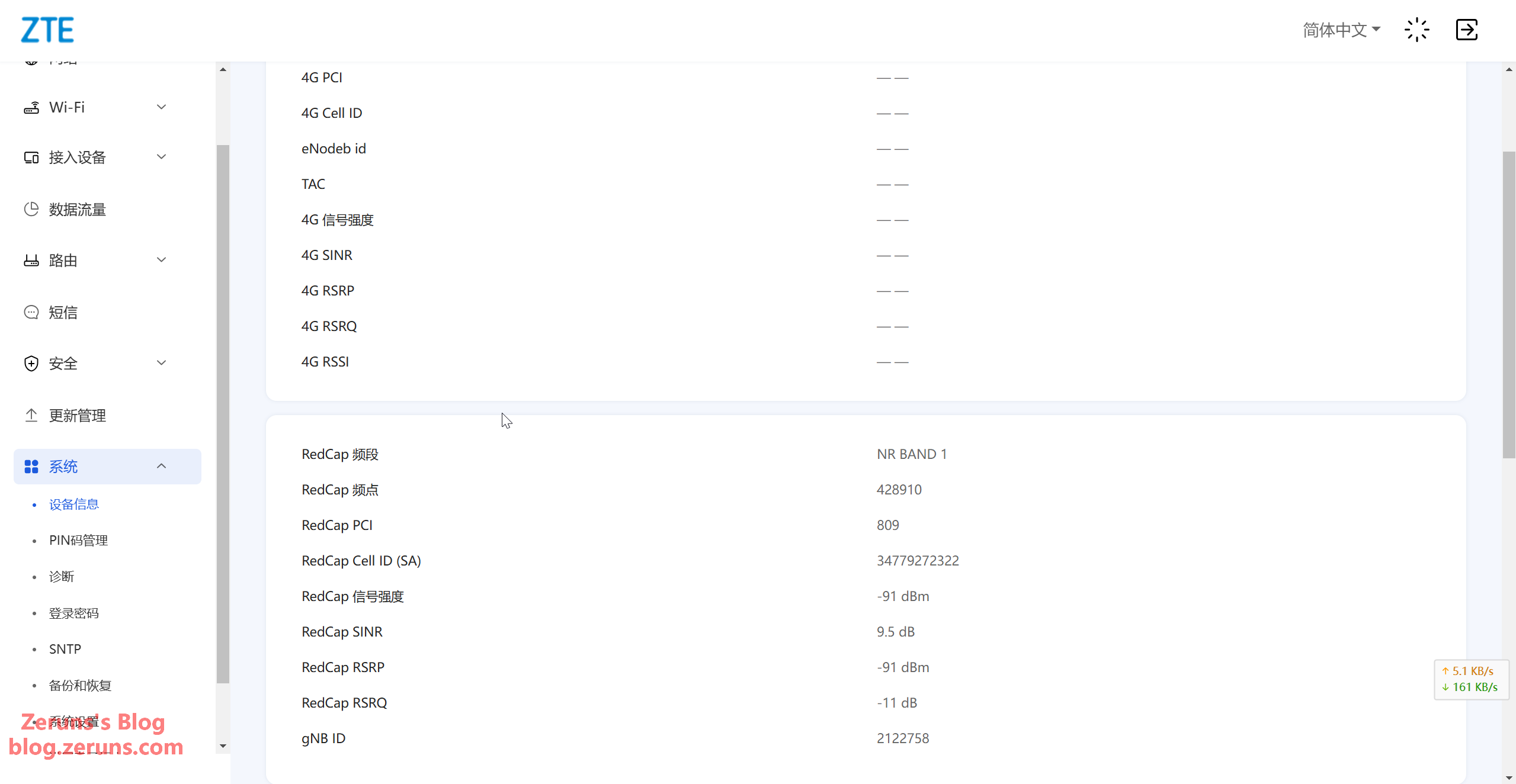
Device Info: Shows detailed cellular data including bands, signal strength, EARFCN, Cell ID, etc.
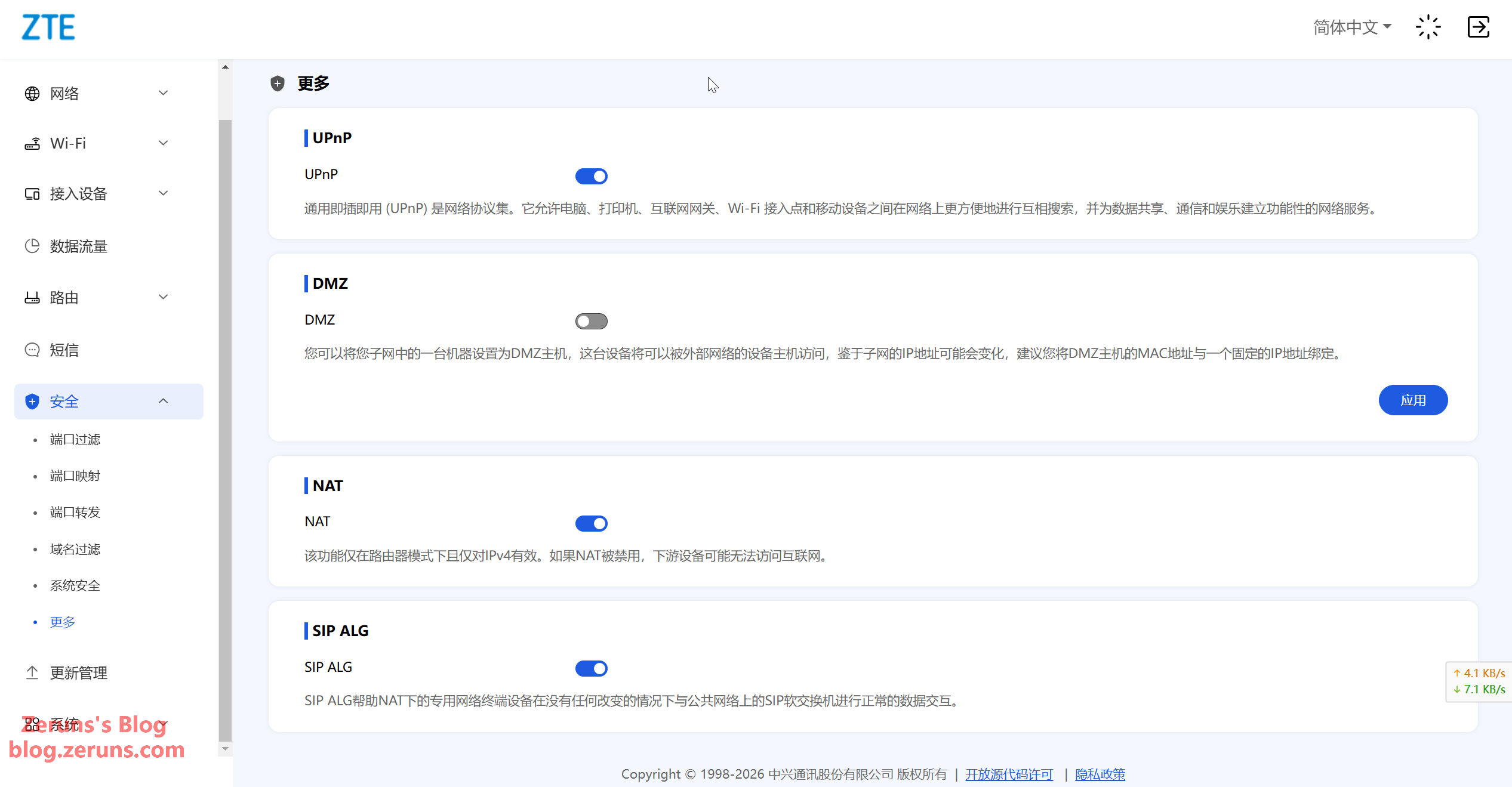
Security Settings: Allows enabling UPnP and DMZ.
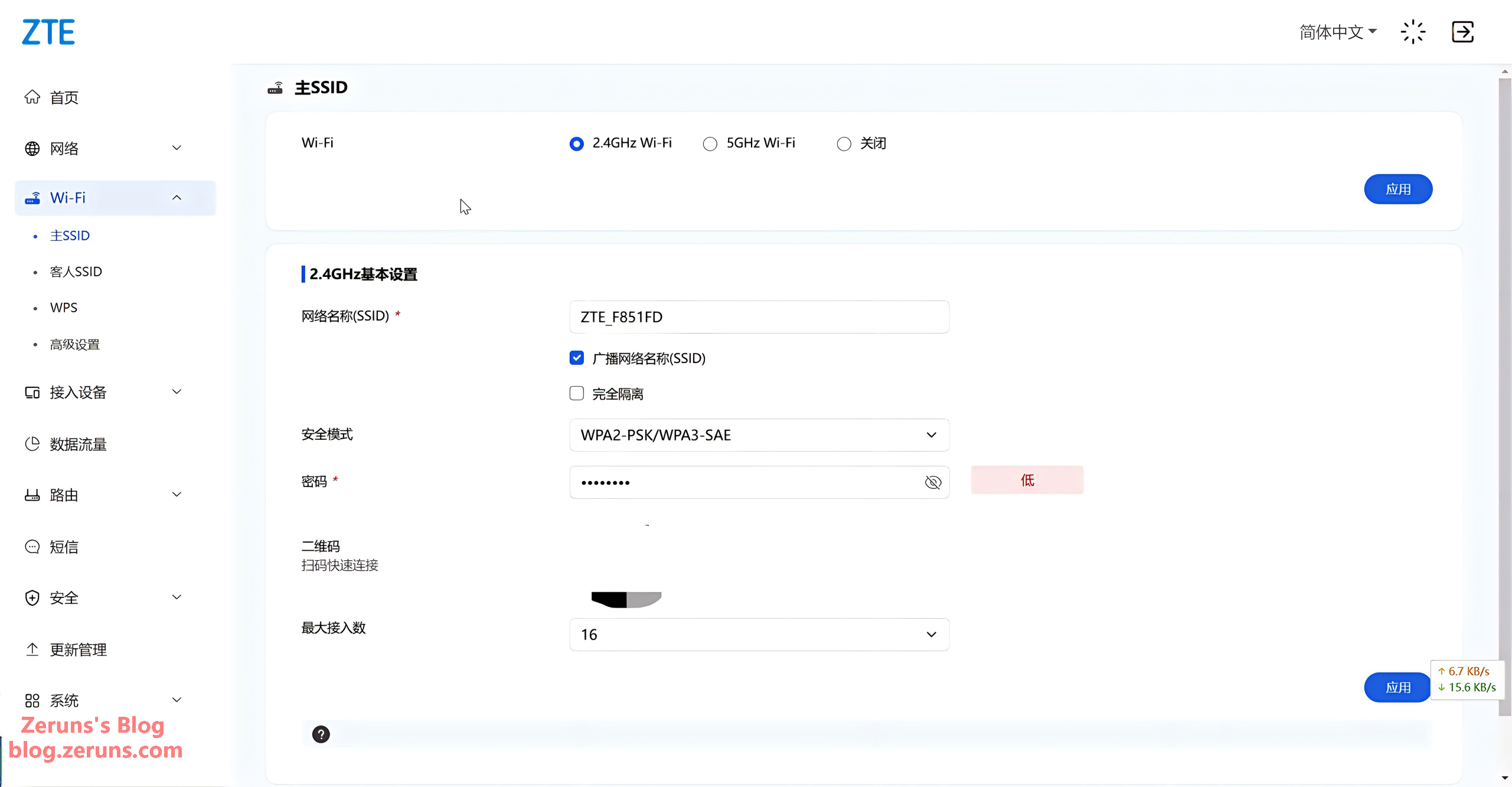
Wi-Fi Settings: Select between 2.4GHz or 5GHz modes.
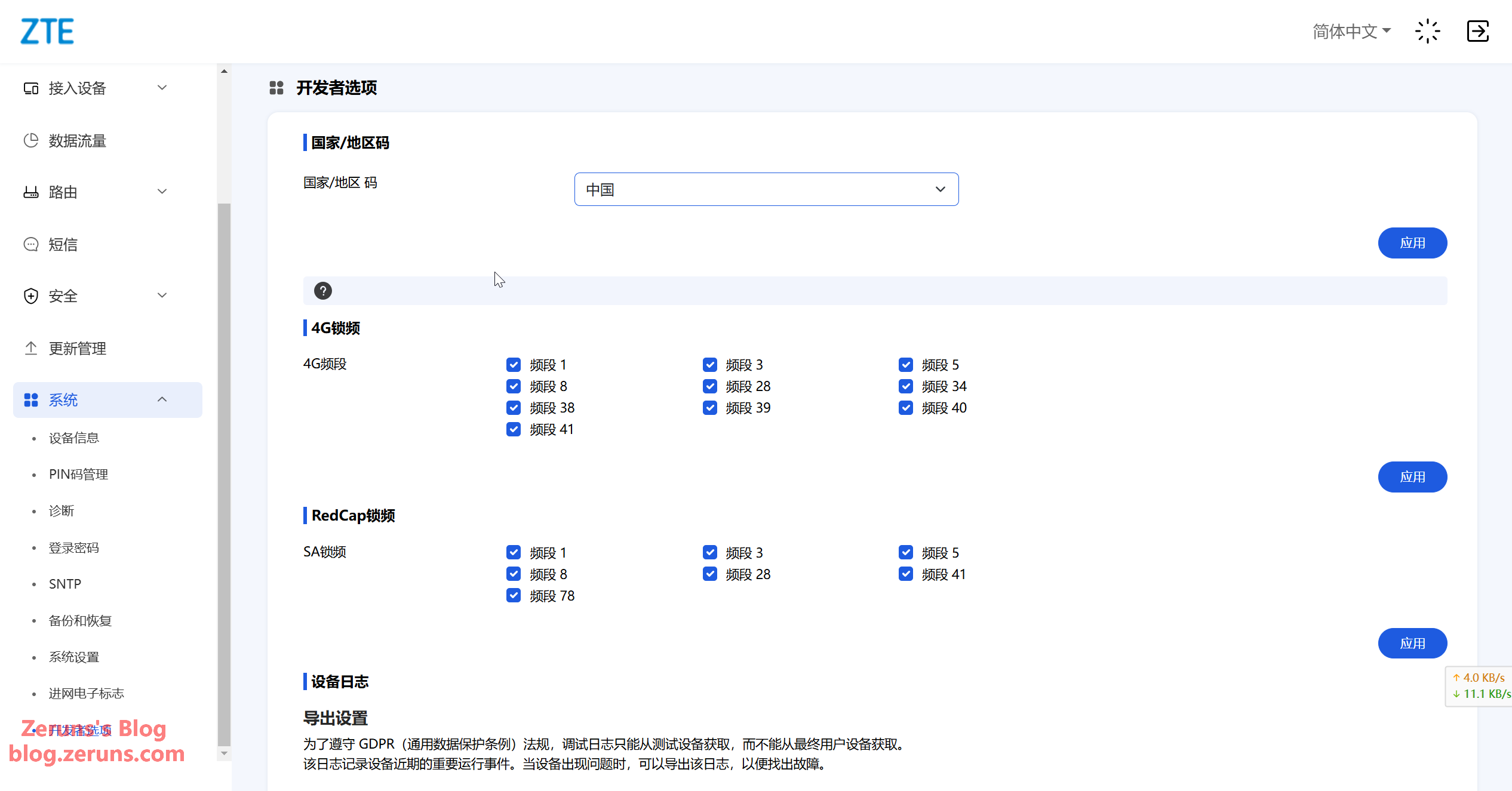
Developer Options: Country/Region code settings and Band Locking. (Band locking forces the device to stay on a specific 4G/5G band to avoid congestion/interference, stabilize speeds, and reduce lag from band-hopping).
5G Frequency Band (NR) Comparison Table
| Band | Frequency Range | Peak Rate & Bandwidth | Main Operators (China) | Characteristics & Scenarios |
|---|---|---|---|---|
| n1 | 1920-1980MHz (UL)2110-2170MHz (DL) | ~400-600Mbps (40MHz) | Unicom, Telecom (Shared) | FDD Mid-band. Balanced coverage and capacity. Strong uplink; used for urban continuous coverage and high-band (n78) infill. |
| n3 | 1710-1785MHz (UL)1805-1880MHz (DL) | ~300-450Mbps (30MHz) | Unicom, Telecom | FDD Mid-band. Re-farmed from premium 4G bands. Good penetration for broad and deep indoor coverage. |
| n5 | 824-849MHz (UL)869-894MHz (DL) | ~150-200Mbps (20MHz) | China Telecom | FDD Low-band. Low attenuation, wide range. Used for rural areas, highways, and basements. |
| n8 | 880-915MHz (UL)925-960MHz (DL) | ~150-200Mbps (20MHz) | China Mobile, Unicom | FDD Low-band. "Golden Band" with high diffraction. Used for rural coverage, maritime, and IoT (RedCap) foundations. |
| n28 | 703-748MHz (UL)758-803MHz (DL) | ~350-450Mbps (30/40MHz) | Broadnet, Mobile (Shared) | FDD Low-band (700MHz). Ultra-low propagation loss. Main driver for 5G expansion into rural markets and VoNR voice. |
| n41 | 2515-2675 MHz | ~1.5 Gbps+ (100/160MHz) | China Mobile | TDD Mid-High Band. Core band for China Mobile 5G. High capacity/speed for cities, towns, and main roads. |
| n78 | 3300-3600 MHz | ~1.5-1.7 Gbps+ (100MHz) | Telecom, Unicom, Broadnet | TDD Mid-High Band (3.5GHz). Global mainstream band. Massive bandwidth for dense urban hotspots (malls, offices, universities). |
4G Frequency Band (LTE) Comparison Table
| Band | Frequency Range | Peak Rate | Main Operators (China) | Characteristics & Scenarios |
|---|---|---|---|---|
| B1 | 2110-2170 MHz (DL) | ~150 Mbps (20MHz) | Unicom, Telecom | FDD Mainstay. Re-farmed 3G band for 4G capacity in cities. |
| B3 | 1805-1880 MHz (DL) | ~150 Mbps (20MHz) | Mobile, Unicom, Telecom | FDD Core. Most common 4G band globally; backbone carrier balancing speed/coverage. |
| B5 | 869-894 MHz (DL) | ~75 Mbps (10MHz) | Telecom, Unicom | FDD Low-band. Long distance; used for rural coverage and NB-IoT. |
| B8 | 925-960 MHz (DL) | ~75 Mbps (10MHz) | Mobile, Unicom | FDD Low-band. 2G/3G re-farmed for indoor depth (elevators, garages) and VoLTE. |
| B28 | 758-803 MHz (DL) | ~150 Mbps (20MHz) | Broadnet (Mobile shared) | FDD Low-band. Provides extreme range in remote areas, forests, or at sea. |
| B34 | 2010-2025 MHz | ~50 Mbps (15MHz) | China Mobile | TDD Band. Re-farmed TD-SCDMA. Narrow; used for hotspot supplements. |
| B38 | 2570-2620 MHz | ~100 Mbps (20MHz) | China Mobile | TDD High-band. Low interference; used for capacity absorption in dense areas (stations). |
| B39 | 1880-1920 MHz | ~100 Mbps (20MHz) | China Mobile | TDD Mainstay. Balanced band for urban continuous coverage and indoor distribution. |
| B40 | 2300-2400 MHz | ~100 Mbps (20MHz) | All three | TDD Indoor. Mainly used for Indoor Distribution Systems (malls, subways). |
| B41 | 2515-2675 MHz | ~300 Mbps+ (CA) | All three | TDD High-capacity. Abundant resources; uses Carrier Aggregation (CA) for high-traffic urban peaks. |
Recommended Reading
- Affordable VPS/Cloud Server Recommendations: https://blog.zeruns.com/archives/383.html
- Minecraft Server Hosting Tutorials: https://blog.zeruns.com/tag/mc/
- Discourse Forum Setup Guide: https://blog.zeruns.com/archives/919.html
- Cross-border E-commerce / WordPress Site Building: https://blog.zeruns.com/archives/889.html
- Halo Blog Deployment via 1Panel: https://blog.zeruns.com/archives/858.html
- [Open Source] PD 65W GaN Charger (ACF) based on DK8607AD: https://blog.zeruns.com/archives/930.html
评论